



Demo investing is a way to practice stock or cryptocurrency trading without using real money. It helps beginners learn the trading structure by being able to enter orders with virtual funds and check profits and losses due to price changes.
What you need to know before starting mock investmentThere are seven major categories: trading platform, virtual funds, order type, transaction cost, leverage, risk management, and transaction history. If you understand each item in advance, you can use simulated investment for systematic trading practice rather than simply competing for returns.
Key takeaways Mock investing is a way to practice trading with virtual funds instead of real money. Before starting, you should check the trading product, platform features, and order type. It is important to understand the basic principles of fees, leverage, forced liquidation and stop loss. Setting realistic virtual funds and writing a trading journal will help you practice systematically. Simulated investment performance does not guarantee actual investment returns. |
What is mock investing and why is it needed?
Paper trading is a method of practicing buying and selling financial products using virtual funds instead of real money. Investors can enter orders, check profits and losses from price changes, and test various trading strategies in a simulated trading environment.
The main purposes of simulated investment are as follows.
Learn how to trade: Learn the basic trading process, including order entry, execution confirmation, and position closing.
Practice your investment strategy: Set buying and selling conditions and compare results in various market situations.
Risk Management Training: Stop loss, position size, and fund allocation criteria are applied repeatedly.
The biggest difference between simulated investment and actual investment is whether or not actual funds are used. Trading losses incurred in simulated investments are reflected only in the virtual account, but losses in real investments lead to a decrease in real assets.
However, simulated investments may not completely reproduce transaction costs, order execution methods, and psychological pressure. Therefore, simulated investment results do not guarantee actual investment performance.
Before starting mock investment Difference between simulated investment and actual investmentUnderstanding can help you differentiate between the risks of virtual and real trading.
7 things you need to know before starting mock investing
1. Check mock investment platform and trading products
Before starting mock investment, you must first decide which financial product you want to practice on. This is because the trading products and functions supported differ depending on the platform.

Representative practice targets are as follows:
stock: Practice stock price fluctuations, buy/sell orders, holding returns, etc.
Cryptocurrency spot: Learn about buying and selling and price fluctuations of cryptocurrencies such as Bitcoin.
Futures Trading: Understand long and short positions, leverage, margin, and liquidation structure.
When choosing a platform, you should check not only the trading products but also whether the price data is real-time, order type, fee reflection method, and transaction recording function.
In particular, if you are practicing futures trading, it is important to look at how the platform handles margin and liquidation conditions.
The specific process from platform selection to first order is How to do mock investmentYou can check it here.
2. Set virtual funds and investment goals
In mock investment, it is best to set a virtual fund of a size similar to the amount that can actually be invested.
For example, if you plan to invest 1 million won in the future, you can practice with virtual funds based on 1 million won. If you trade with virtual funds that are too large compared to the actual investment amount, your sense of position size and loss may differ from reality.
Also, before starting mock investment, you must set a specific practice goal.
For example, you could spend the first week learning market and limit orders, and the next week focus on stop loss and position size management.
It is more important to consistently follow established trading principles than to record high returns in a short period of time.

3. Understand order types such as market price and limit price
If you do not understand the order type, the trade may be executed at a different price than expected or the order may not be filled.
The spell types that beginners should know first are as follows.
order type | meaning | characteristic |
Market Order | An order to buy or sell at the price available in the current market. | Priority is given to quick execution, but prices may vary. |
Limit Order | An order to set a trade at a desired price or a more favorable price | Price terms can be specified but may not be concluded |
Stop Order | How a given order becomes activated when a certain price is reached | It is used for stop loss, etc., and the detailed operation method depends on the order type. |
For example, if the price of Bitcoin is 100,000 won and you place a limit purchase order at 99,000 won, the order may not be executed if the price does not reach that level or if there is not enough volume to execute.
Therefore, it is necessary to distinguish between the fact that an order has been entered and the fact that it has actually been executed.
The terms and conditions for each order and how to use them are as follows: Difference between market price, limit price, and stop orderIt is easy to understand by referring to .
4. Check fees and slippage
Transaction costs must be considered when evaluating simulated investment returns.

Representative costs and market factors are as follows.
Transaction Fee: Fees charged by the platform or exchange when an order is executed
Spread: Difference between buy price and ask price
Slippage: Difference between expected price and actual contract price
For example, let's assume that a 0.05% commission is applied when entering and exiting a position worth 1 million won. If the transaction value is 1 million won in both directions, the total fee is 1,000 won.
If you repeat short-term trades multiple times, these costs can accumulate and affect your final returns.
Some mock investment platforms may reflect commissions and slippage differently from reality or may not support some items. Therefore, you must check the applicable conditions when analyzing transaction results.
5. Understand leverage and liquidation risk
If you start mock futures investing, you must understand the relationship between leverage and liquidation.
Leverage is a structure that allows you to operate a position larger than the margin you have. If the price moves favorably, the return on margin can increase, but if the price moves in the opposite direction, losses also increase quickly.
For example, if you apply 10x leverage to a margin of 1 million won, you will operate a position worth about 10 million won.
In the case of a long position where the price of the underlying asset falls by 3%, a loss of approximately 300,000 won will occur based on simple calculation. This corresponds to 30% of the initial margin.
The actual forced liquidation price varies depending on various conditions such as maintenance margin, transaction fee, and margin method. Therefore, the exact liquidation price should not be determined simply based on the leverage ratio.
Especially in futures trading, it is good to understand in advance the difference between cross margin and isolated margin.
To understand losses and liquidation price changes due to leverage Calculation of liquidation price by coin futures leverageIt is a good idea to look at it together.

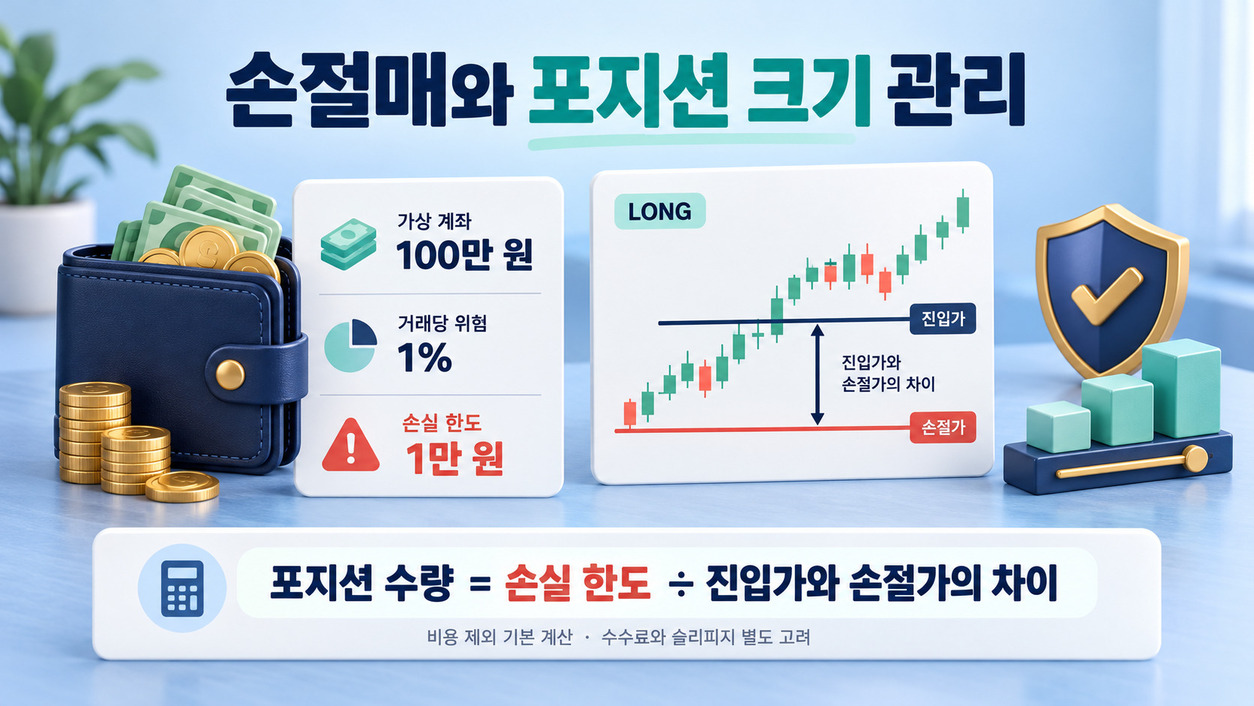
6. Manage stop loss and position size
Even in mock investment Stop-LossYou need to get into the habit of managing your position size.
Stop loss is a method of closing a position according to predetermined criteria to limit losses when the price moves differently than expected. However, depending on market conditions, the actual execution price may differ from the set price.
For example, if you have 1 million won in your virtual account and decide to take a loss of up to 1% in one transaction, the loss limit is 10,000 won.
At this time, the appropriate position size must be calculated based on the difference between the entry price and the stop loss price. It is also a good idea to consider transaction fees and slippage.
In simulated investing, these criteria must be applied repeatedly, even if losses do not affect real money. This will help you avoid transactions of a size that is difficult to handle in actual investment.
Also, avoid being overly dependent on the platform. Simulated investment riskmust be fully aware of.
7. Preparation of trading journal and analysis of results
To improve simulated investment results, it is a good idea to keep a trading journal.
The following information can be recorded in the sales journal:
Transaction date and product
Reasons for entry and market conditions
Entry price, stop loss, target price
Position size and leverage
Trading results and areas for improvement

For example, even if a loss occurs, it can be evaluated positively from a risk management perspective if the pre-determined stop loss standard is followed.
Conversely, even if you have achieved high profits, if you increase leverage without planning, you should review the risk of the transaction.
In simulated investment, not only the rate of return How consistently have you followed your trading principles? It is important to check.
Checklist before starting mock investment
Before starting the actual practice, let's check the following items.
check items | Confirmation details |
trading products | What should you practice: stocks, coins, or futures? |
trading platform | Does it support the ordering functionality and pricing data you need? |
virtual money | Have you set a realistic practice amount? |
order type | Do you understand the difference between market price and limit price? |
transaction cost | Have you checked whether fees and slippage are reflected? |
risk management | Have you set a stop loss standard and maximum loss? |
transaction history | Are you ready to write a trading journal? |
You do not have to be completely familiar with all items to start mock investment. However, it is a good idea to understand the basic concepts and make it a habit to check them one by one during the transaction process.
What you need to know before starting mock investmentIt includes not only trading platforms and order types, but also virtual funds settings, trading costs, leverage, loss management and trade history. If you understand these basic principles, you can use mock investing as a more systematic learning process.
Before using real funds ASUNMOLet's practice trading with virtual funds and experience the profit and loss and position management process according to the market direction. Mock investing helps you learn trading, but it does not guarantee actual investment performance.
0 Comments
No comments yet. Be the first to share your thoughts.