


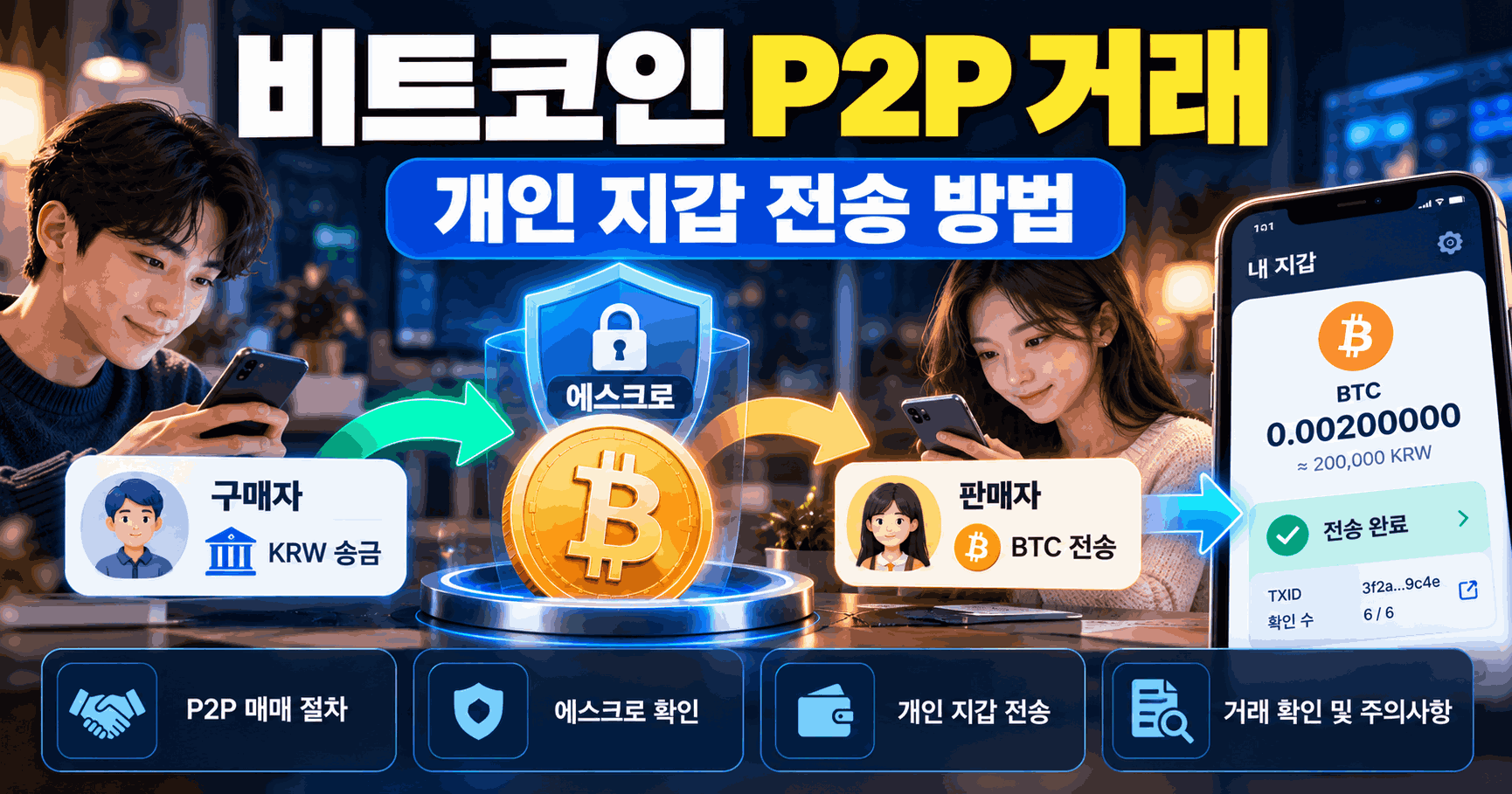
Bitcoin P2P Tradingis a peer-to-peer transaction method in which buyers and sellers directly agree on transaction conditions such as BTC price, quantity, and payment method. Unlike typical exchange order book transactions, payment confirmation and Bitcoin delivery procedures can be carried out separately, and some platforms provide an escrow function.
To transfer Bitcoin purchased through P2P to a personal wallet BTC receiving address, network, transfer fees and blockchain verification statusmust be accurately understood. In particular, caution is required as Bitcoin sent to the wrong address is difficult to return.
In this article Bitcoin P2P transaction method, learn about buyer and seller transaction procedures, how to transfer BTC to a personal wallet, and key fraud prevention tips.
(Caution: This content is for educational purposes only and does not constitute investment advice or legal advice.)
What is peer-to-peer Bitcoin trading?
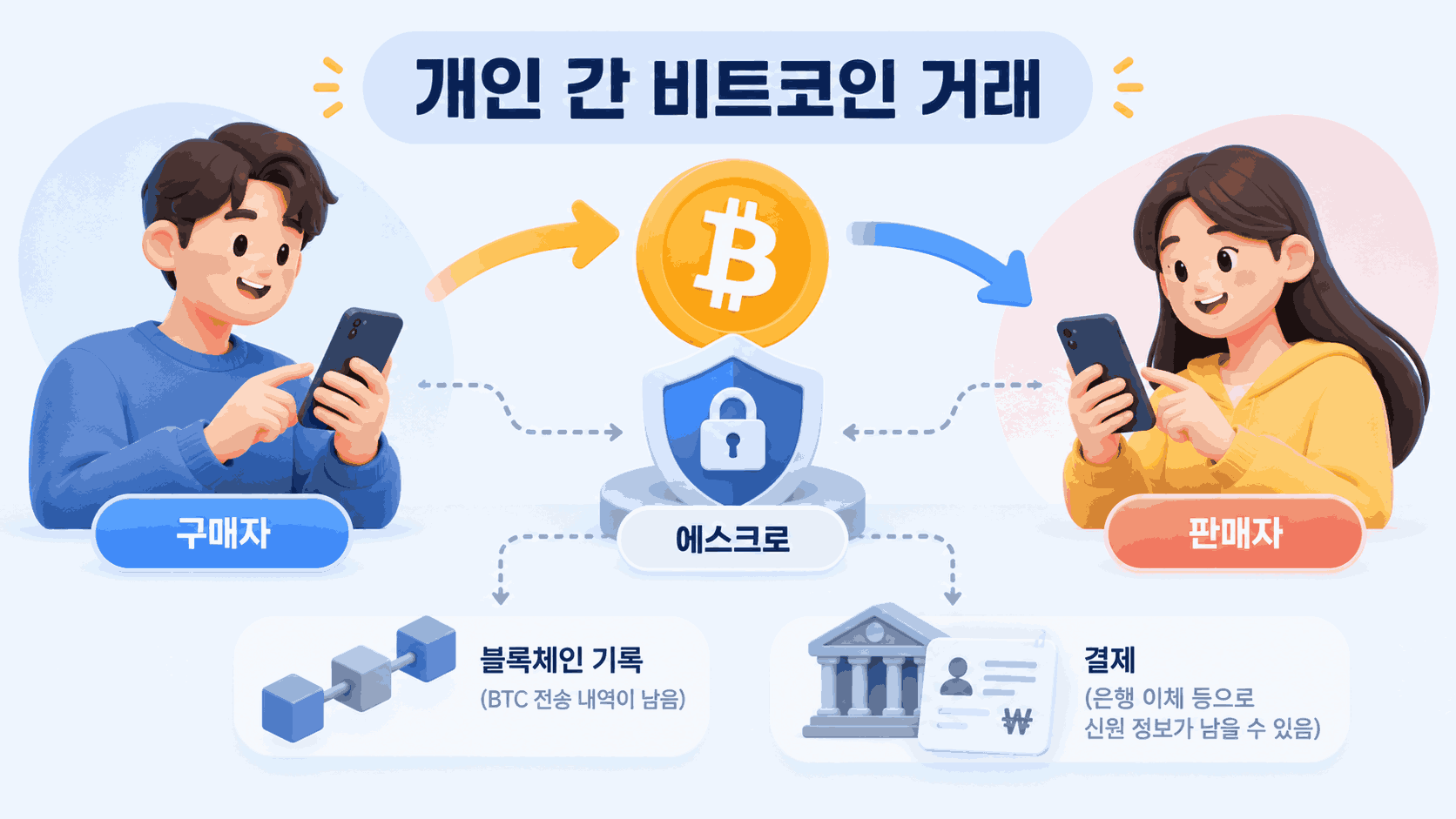
Peer-to-Peer (P2P) Bitcoin transactions between individualsis a transaction in which the buyer and seller directly agree on the price, quantity, payment method, and BTC delivery time. Some platforms provide brokerage escrow functions, but in other cases, parties transact outside the platform. P2P does not mean anonymous transactions. BTC transfer details are recorded on the blockchain, and identity information may remain in bank payments.
Basic structure of peer-to-peer Bitcoin transactions
A typical transaction consists of four steps: determining the counterparty and terms, storing or confirming BTC, paying according to the agreed upon method, and delivering BTC after payment confirmation. If you use escrow, you need to find out who controls your pending BTC and what the appeal process is. Escrow reduces some risks but does not prevent all types of fraud.
Hypothetical example: Two people agree to buy or sell 0.002 BTC for a total of 200,000 won. If the on-chain transfer fee is deducted from the transfer quantity, the amount of BTC the buyer actually receives may vary. Prices and amounts are only examples and do not represent the current market price.
Difference between peer-to-peer and exchange trading
division | Peer-to-peer transactions | Exchange order book trading |
transaction price | The parties negotiate or select the quoted price. | Executed according to existing buy and sell orders |
payment | Inter-party payment methods may be used, subject to platform terms | Using exchange balance and system |
Transaction Fulfillment | Depends on counterparty and presence of escrow | Depends on exchange matching system and regulations |
main risk | Payment Fraud, Disputes, Invalid Address | Platform, price, liquidity and asset withdrawal risks |
No matter which method you choose, you must check the service provider's qualifications, deposit/withdrawal regulations, and source of payment funds.
Bitcoin P2P transaction method
Before starting a transaction, choose a service that has clear terms and conditions and meets the regulations in your area. Never send money or BTC based solely on private messages, screen captures, or promises to handle it later.
Buyer Procedure
Select a counterparty and check the terms: BTC price, transaction limits, fees, payment deadlines, transaction history, and dispute resolution procedures if disclosed by the platform.
Confirm the received quantity: Agree on the amount to be paid, the amount of BTC, the receiving address, and who will bear the network fee. The BTC quantity before and after fee deduction must be distinguished.
Make payments according to official instructions: confirm the beneficiary name and transfer money only to accounts permitted by the service rules. Even if an account change request is made in a chat outside the system, it is not followed.
Follow the procedures to indicate payment completion and retain proof: A valid transfer confirmation may be helpful in handling disputes, but it is not proof that the seller received payment.
Confirm the BTC you actually received: Check the escrow status or receiving wallet. If you withdraw money to a personal wallet, check the transaction ID (TXID) and blockchain confirmation number.
Example: Assume the consensus price is 100,000 won per 0.001 BTC. Even if the seller transfers 0.001 BTC, the buyer may receive less if the network fee is deducted from the transfer amount. Therefore, the conditions regarding the ‘actual received BTC quantity’ must be clarified in advance.
Seller Procedures
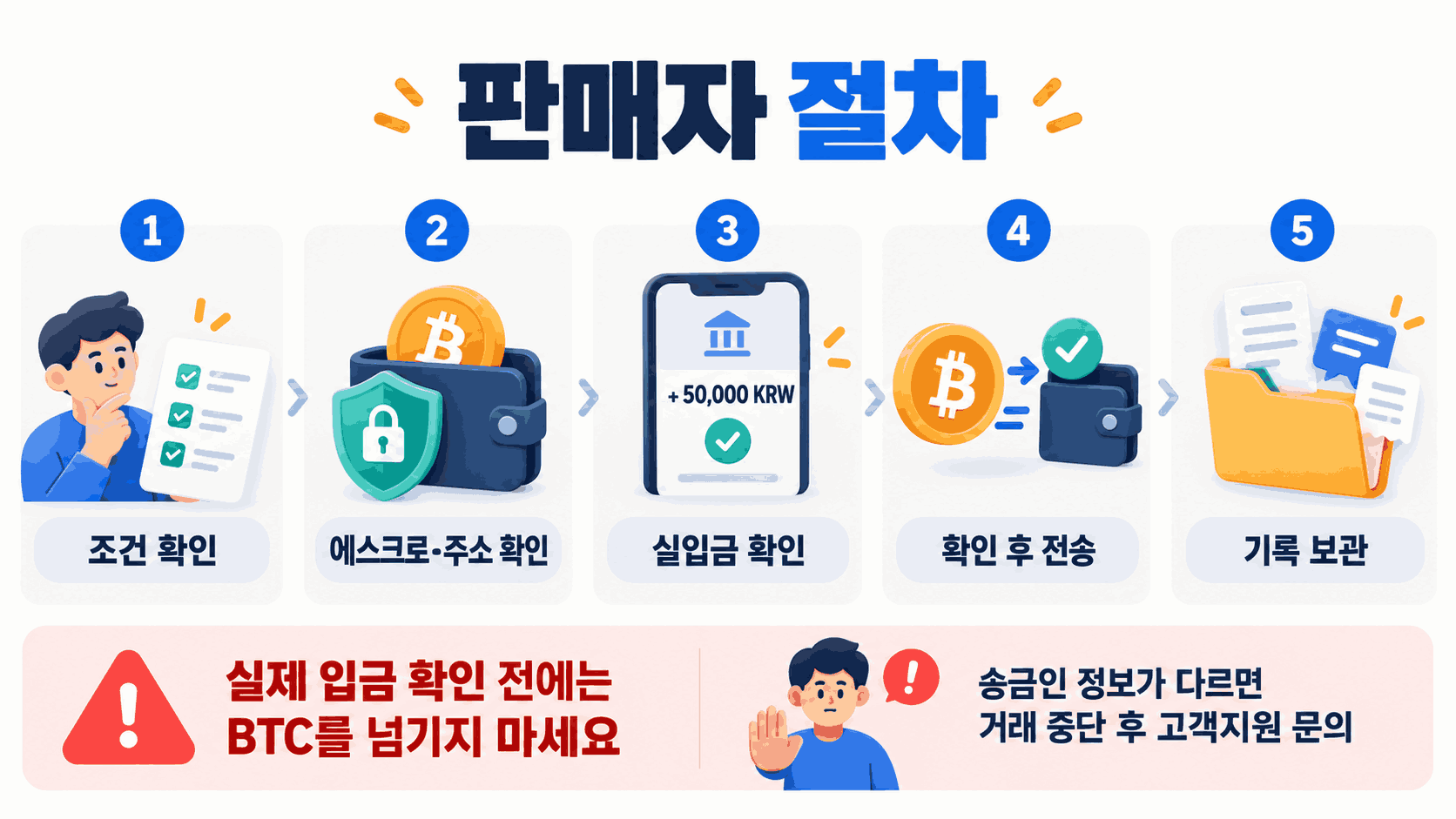
Confirm purchase request and conditions: BTC quantity, price, payment method, deadline, fee, and escrow conditions.
If necessary, deposit the BTC into the platform's asset custody procedures or verify the buyer's address according to the security procedures of your choice.
Wait for the money to actually arrive: Log into your bank app through the official channel and check the deposit details, sender's name, and availability.
Only release or transfer BTC after directly confirming the payment: Do not trust ‘payment completed’ notifications in chat, fake emails, or images of transfer confirmations.
Receipts, transaction identification information and conversations are kept in compliance with data protection regulations so that disputes may arise.
Even if you rush the clock, you should not hand over your BTC until the money is actually deposited into your account. If the sender's information does not match what was agreed upon, stop the transaction and contact customer support.
How to transfer bitcoin to your personal wallet
A private wallet (self-custody wallet) allows users to directly manage their private keys or recovery phrases. Balance held on the exchangeUnlike , key holders are responsible for their own wallet security and recoverability. You should choose a wallet that actually supports Bitcoin on the Bitcoin network. Wallets that support wrapped BTC tokens from other networks do not automatically receive native BTC.
Set up a trusted wallet that supports native BTC. Follow the official instructions and keep your recovery phrase offline before making a deposit.
Open the Receive/Bitcoin receiving menu in your wallet and check the receiving address of the Bitcoin network. Especially if you copied it to the clipboard, check it against the address displayed on your device.
Select the correct BTC withdrawal and Bitcoin network from your exchange or transfer wallet. Check fees, withdrawal BTC quantity, expected arrival BTC quantity, and address confirmation/approval requirements.
If the platform and fee conditions allow, send a small amount first. Look up the TXID in the blockchain explorer and wait until the appropriate number of confirmations is reached.
After the test transaction is recorded, review the transfer of the remaining funds. Each time you withdraw money, reconfirm the receiving address and keep the transfer information.
Hypothetical example: When withdrawing 0.0100 BTC from an exchange, the withdrawal fee of 0.0001 BTC is deducted from the withdrawal amount, and 0.0099 BTC will be received in your wallet. However, some exchanges charge fees separately from the withdrawal amount, so you should read the actual calculation method before checking.
Note for Korean users: Some exchanges apply account name verification, travel rules, and a list of registered/allowed personal wallets. You should not assume that any Bitcoin wallet can withdraw money directly from any exchange. Upbit's personal wallet withdrawal instructions specifically specify which wallets are supported, so you should check again just before withdrawal.
Risks and Precautions of Bitcoin P2P Transactions
P2P transactions involve both regular payments and blockchain asset transfers. Many factors must be controlled as deposit processing timings, refund rights, platform rules, and the difficult-to-revert nature of BTC transactions vary.
Types of fraud that can occur
category | Signs and prevention methods |
fake transfer confirmation | This is a case where the buyer sends a transfer image, but the money is not deposited into the bank account. Deposits are confirmed only through the official app. |
Impersonating customer support/escrow | It asks you to click on an unfamiliar link, send additional money, or provide a password. Processed only through official channels. |
Change receipt information | The message asks you to transfer money to another account. Stop the transaction and confirm through the platform. |
Third party payment | The name of the remitter does not match the contents of the agreement. Disputes may arise or additional confirmation may be required. |
Change wallet address | Malicious software changes the address of the clipboard. On the wallet screen, the entire information, not just the first and last characters of the address, is compared. |
unconfirmed transaction | Completion cannot be guaranteed with just the TXID that has just been propagated to the network. Wait for the appropriate number of verifications before handing over goods or assets. |
If fraud is suspected, stop the transaction, keep the evidence, and immediately contact the relevant platform and bank. Verified BTC can be very difficult or impossible to track or retrieve.
Personal Wallet Security Checklist
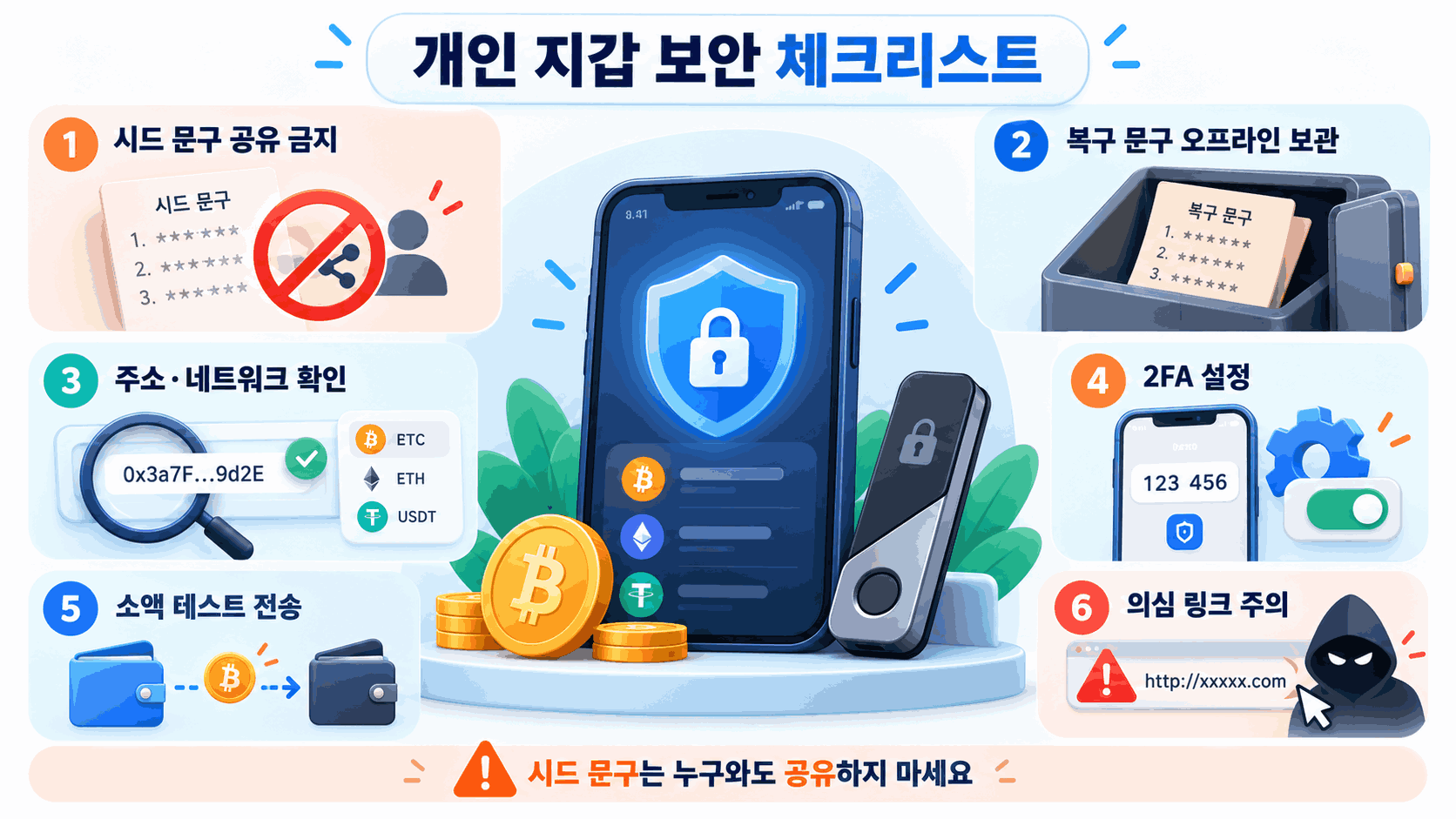
Never share your seed phrase, private key, or authentication code with anyone, including anyone pretending to be customer support.
Recovery phrases are recorded offline and images are never saved to your phone photo library, email, or unprotected cloud.
Before sending, check the wallet download URL, software source, network, and receiving address.
Set up multi-factor authentication on your exchange account, keep your device up to date and watch out for fake browser extensions.
Before storing large sums, test recovery according to your service provider's safety guidelines and review hardware wallets as needed.
Do not enter your seed phrase on ‘wallet verification’ websites, airdrop forms, or links sent by strangers.
In terms of Korean law, it cannot be concluded that all P2P transactions are legal or prohibited based on the name of the transaction method alone. Legality depends on the size and repetition of the transaction, whether services are provided for others, and the reporting obligations and anti-money laundering requirements of the business. Specific issues must be confirmed through current regulations and expert advice.
Peer-to-peer Bitcoin Transactions Frequently Asked Questions
1. Are peer-to-peer Bitcoin transactions legal?
There is no single answer that applies to all countries and types of transactions. In Korea, a distinction must be made between individual trading between individuals and virtual asset business activities that may result in reporting and legal compliance obligations. Before trading, you should check the current regulations, funding sources, tax obligations and platform requirements.
2. Can I cancel Bitcoin sent to a personal wallet?
Transactions confirmed on the Bitcoin blockchain, in principle, do not have an undo function. To get BTC back, the recipient usually has to voluntarily send it back. Fallback mechanisms may be applied for some unconfirmed transactions depending on settings and network policies, but this should not be viewed as a way to guarantee cancellation of transmission.
3. Are there fees when transferring Bitcoin to a personal wallet?
Typically, Bitcoin network fees are incurred and platform withdrawal fees may be added. Since the fee varies depending on the network situation and the remittance party's policy, you must check the amount of BTC that will arrive in your wallet before confirmation.
4. How long does it take to transfer BTC?
The time taken will vary depending on the exchange's processing of the withdrawal request, transaction fees, network congestion, and the number of confirmations required by the receiving party. There is no fixed time that applies to all transactions.
5. Is it better to learn using a mock account first?
Before using real funds, you can learn buy and sell orders, price fluctuations, and risk management concepts with virtual funds. Bitcoin mock tradingIt helps you learn the transaction process, but does not replace testing BTC transfers on the blockchain or private key security training.
Bitcoin peer-to-peer transactions can be made more secure when both parties clearly understand the fund flow, BTC control rights, and confirmation rules. For each transaction, we check the counterparty, payment, wallet address, and service policy. In self-custodial wallets, we prioritize private key protection and start with a small test.
Good article to read together
What are spot stocks? Bitcoin/Coin spot meaning and trading method
5 risks of simulated investment and precautions before actual investment
Bitcoin P2P TradingIn this case, buyers and sellers must accurately check transaction terms and verify actual payment and receipt of BTC, respectively. When transferring Bitcoin to a personal wallet, it is important to check the network, wallet address, fees, and TXID. In particular, you must securely manage your private key and recovery phrase, and fully understand the risk of fraud and platform usage regulations before trading.
0 Comments
No comments yet. Be the first to share your thoughts.