



Foreign futures marginSilver is a collateral asset that must be deposited into an account to open and maintain a futures position. By understanding how to calculate foreign futures margin, you can check the funds required before trading and the risk of insufficient maintenance margin.
The margin for overseas futures does not apply equally to all products. The amount may vary depending on the product, number of contracts, market volatility, and exchange and brokerage standards, so you should check the latest margin table.
What is futures contract margin?
Margin is an asset that traders deposit to secure fulfillment of their obligations when opening and maintaining futures positions. It is not a price paid to own the underlying asset.
initial margin
Initial MarginThis is the margin required to open a silver position. In linear coin futures, the position value and leverageIt depends.
For example, if you apply 10x leverage to a position of 1,000 USDT, the default margin excluding commission is 100 USDT.
maintenance margin
Maintenance MarginThis is the minimum margin that must be met to continue holding a silver position. If the collateral assets do not meet the requirements due to losses, the position will be canceled according to the platform's regulations. forced liquidationIt can be.

Futures contract margin calculation in 3 steps
The example below is USDT linear contractIt does not apply equally to inverse contracts or to all traditional futures products.
Step 1: Check position value
If the quantity is displayed in coins:
Position value = Coin quantity × Calculation base price
Assume you open a 0.02 BTC position at 50,000 USDT/BTC.
Position Value = 0.02 × 50,000 = 1,000 USDT
If the quantity is displayed in ‘contract’ units on the screen, you must check how many coins one contract corresponds to before calculating.
The prices you use in your calculations must also fit the situation. Bybit uses the order price in its order cost formula, and according to exchange documents, it is used to calculate margin for already opened USDT positions. Mark PriceUse .

Initial margin calculation according to level 2 leverage
The basic formula is:
Initial Margin = Position Value ÷ Leverage
If the position value is 1,000 USDT and the leverage is 10x:
Initial Margin = 1,000 ÷ 10 = 100 USDT
The table below compares position values keeping them the same.
position value | leverage | basic margin |
1,000 USDT | 5 times | 200 USDT |
1,000 USDT | 10 times | 100 USDT |
1,000 USDT | 20 times | 50 USDT |
Figures are hypothetical examples and do not include fees. If the position value is the same, the higher the leverage, the lower the initial margin.
Step 3 Check the amount required for your order
The default margin is not always the same as the amount required by the platform upon order confirmation. Order cost is calculated as follows:
Order Cost = Initial Margin + Entry Fee + Expected Position Exit Fee
So please check the following items before confirming your order:
Initial margin displayed on screen
entry fee
Expected position termination fee reflected in advance
Whether your available balance meets the required amount
Estimated position exit fees may differ from actual fees. This is because the execution price and applicable commission rate may vary.
3 things to check when calculating futures margin
High leverage does not mean low risk
In the example above, a 1% unfavorable move in a position of 1,000 USDT would result in a loss of approximately 10 USDT, excluding costs.
This loss is equivalent to 10% of the margin of 100 USDT, but is 20% based on the margin of 50 USDT. This is an illustrative calculation and is not a formula for calculating liquidation price.
For the same position, the loss amount does not decrease even if the margin decreases.
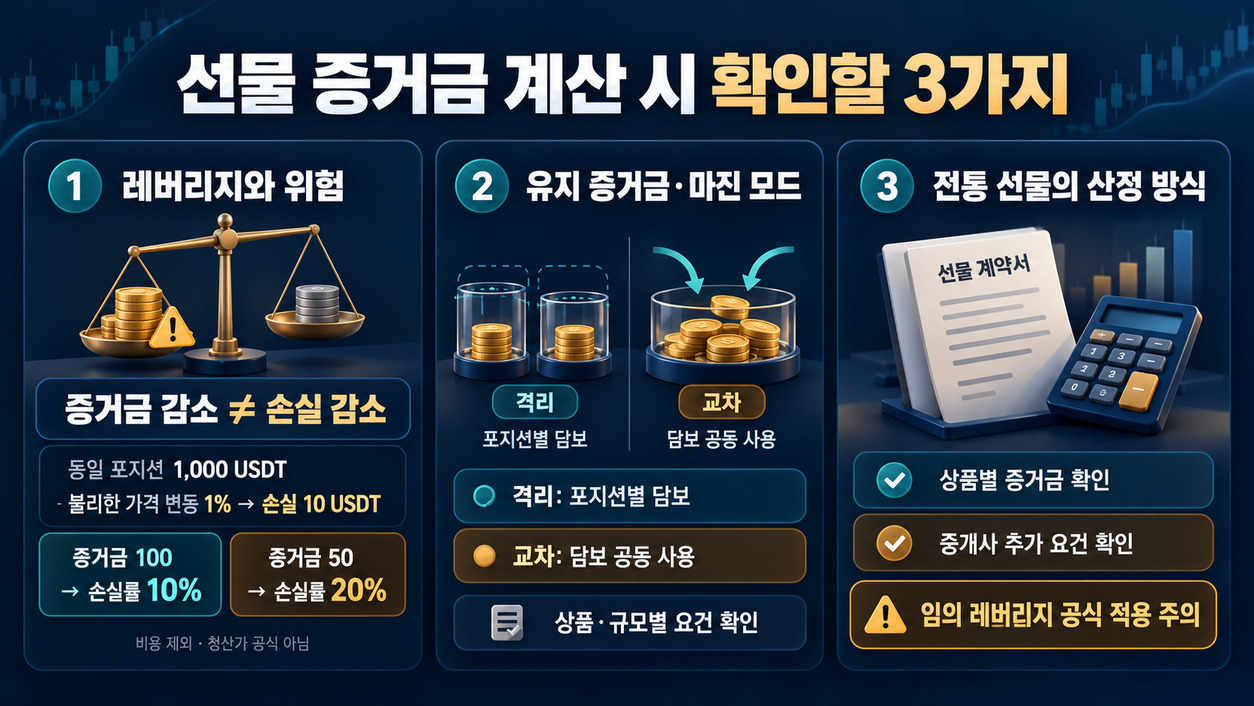
Check maintenance margin and margin mode
Maintenance margin rates may vary depending on the trading pair and position size range. You should not assume that the same rates apply to all contracts.
also Isolated Margin and Cross MarginYou need to check the difference.
Isolated Margin: Margin is calculated separately for each position.
Cross Margin: Depending on the account structure, collateral assets are jointly used, so risk must be managed at the account level.
In Bybit, the forced liquidation conditions for the two modes are also different.
Traditional futures have different margin calculation methods.
For traditional futures, you must check the margin and broker's requirements for each product. According to CME Group, margin levels may vary depending on market conditions, and your brokerage may require additional funds.
Therefore, you should not simply divide the contract value by an arbitrarily chosen leverage.
How to Calculate Futures Contract MarginUnderstanding this will help you determine the funds required before ordering. Compare the formulas, fees and platform requirements and practice with mock trading (paper trading) at ASUNMO.
Frequently Asked Questions
1. Is margin a transaction fee?
no. Margin is an asset that backs a position, and trading fees are costs incurred during the transaction execution process. Bybit separates margin and commission into separate items in order costs.
2. Why is the displayed margin different from the manually calculated result?
We calculated it using the order price, but the platform may have used the Mark Price. Additionally, the margin displayed may include an estimated position termination fee. Correctly compare the item names and formulas on the exchange.
3. Can I practice margin calculation with a mock investment account?
This is possible if the platform supports futures trading and margin marking. Fix the quantity, change the leverage, and compare the results. You should check the rules of mock investing before comparing it to your real account.
Good article to read together
What is a Coin Futures Calculator? Leverage, profit and loss, average entry price calculation method
How to Trade Bitcoin Futures: A Step-by-Step Guide for Beginners
Impact of funding fee on simulated trading results
Foreign futures marginWhen calculating, you must check the initial margin per contract, the number of contracts, and the maintenance margin. You should also consider extra funds to cover fees, exchange rates, and market fluctuations. Before trading, check the latest margin tables and order screens, and practice your calculations with ASUNMO mock investments.
0 Comments
No comments yet. Be the first to share your thoughts.