



Cryptocurrency futures trading fees calculationThis is a necessary process to determine the transaction costs incurred when entering and exiting a position. Futures trading fees are generally calculated based on the actual transaction amount rather than margin, and maker or taker fee rates are applied depending on the order method.
For example, if you open a BTCUSDT futures position and then close it, fees may be incurred in both entry and exit. In perpetual futures trading, funding fees may be paid or received separately, so these must be distinguished when calculating the final profit or loss.
In this article How to calculate cryptocurrency futures trading fees, explains a BTCUSDT transaction example, the difference between maker/taker fees and funding fees, and how to check costs before and after trading.
(Risk Disclaimer: This article is for educational purposes only and does not constitute investment advice. Commission rates and prices are assumptions for illustrative purposes only.)
Key takeaways
Cryptocurrency futures trading feesis generally calculated by multiplying the concluded transaction amount by the applicable commission rate.
Transaction fee = execution quantity × execution price × commission rate
Total trading fee = entry fee + exit fee
P&L after commission = P&L before commission - total transaction fee
Taker fees generally apply to market orders, and limit orders may also be subject to taker fees if they are executed immediately. The funding fee for perpetual futures must be checked separately from the transaction fee.
What are cryptocurrency futures trading fees?
Cryptocurrency futures trading fees are fees charged by the platform when an order is executed. Each time you enter and exit a position, you may incur costs depending on the commission rate applicable to your account.
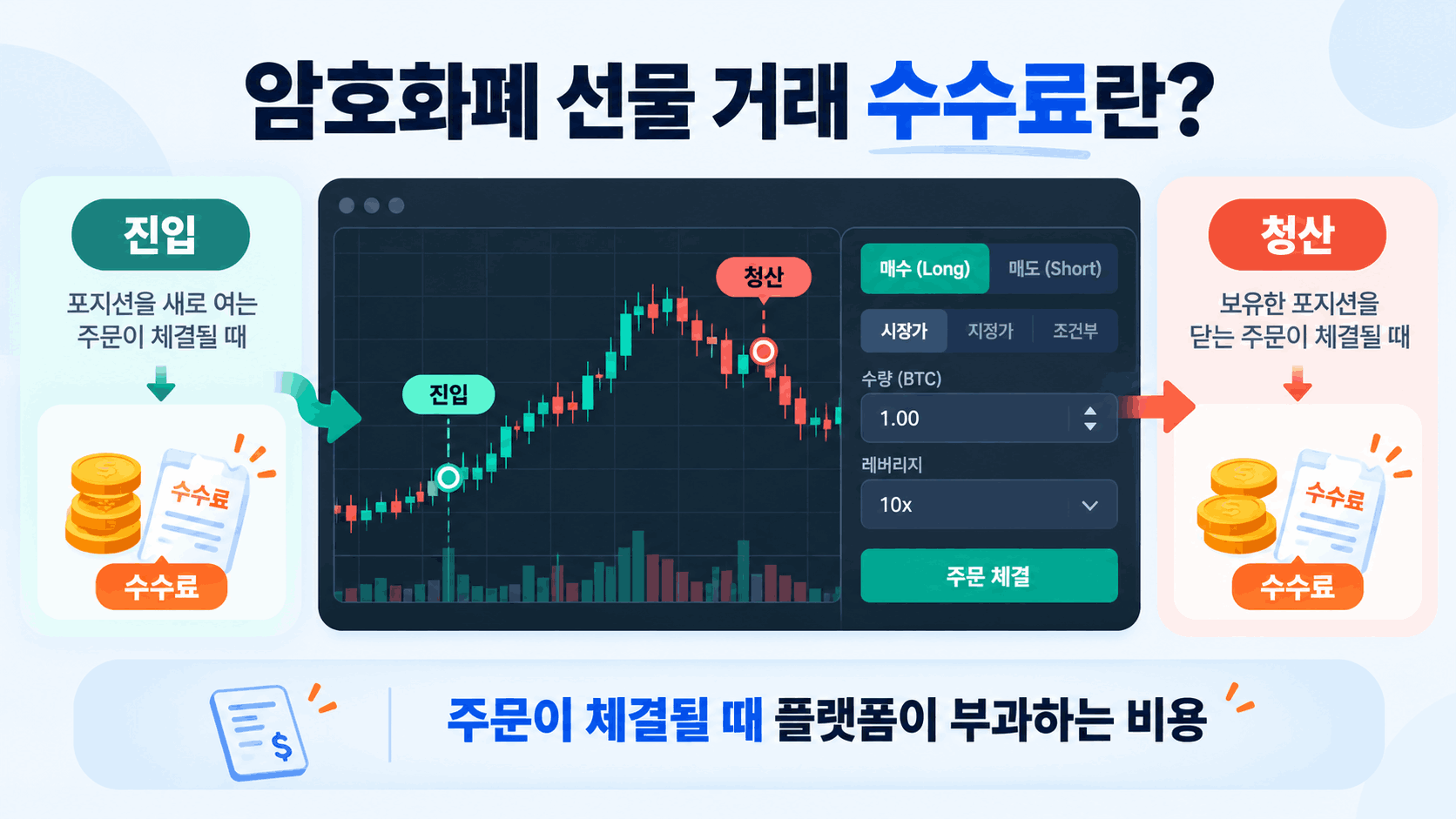
Cryptocurrency futures trading fees are costs incurred when orders are executed during position entry and liquidation.
What are maker fees and taker fees?
Maker: This is an order that adds liquidity to the quotation window and waits for execution.
Taker: This is an order that is executed immediately with the liquidity already in the order window.
A taker fee usually applies to market orders. A taker fee may be applied if a limit order is executed immediately, so you should not assume that a maker fee is applied just because it is a limit order.
To understand in more detail how market and limit orders are executed and how stop orders work, Summary of the difference between limit and market orders and how to use stop ordersIt is recommended to read .
Difference between transaction fees and funding fees
Crypto asset futures trading feesWhen checking, the funding fee must be classified separately. The funding fee is the amount exchanged between long and short positions in a perpetual futures contract, and traders holding positions at the time of payment can pay or receive the funding fee.
In addition, slippage is a phenomenon in which the actual execution price differs from the expected price, which affects trading results, but is not a fee charged by the exchange.
Direction of funding fee payment, timing of calculation and impact on simulated profit and loss Impact of funding fee on simulated trading resultsYou can check in detail here.
Cryptocurrency futures trading fees calculation

Cryptocurrency futures trading fees are calculated by multiplying the execution quantity, execution price, and commission rate, and occur at the time of entry and liquidation, respectively.
Position entry and exit fee calculation formula
The basic formula for a linear contract settled in USDT is as follows:
Transaction fee = Quantity of coins entered into × Conclusion price × Commission rate
These are classified as follows:
Entry fee = Entry quantity × Entry price × Entry fee rate
Clearing fee = Liquidation quantity × Liquidation price × Liquidation fee rate
Total trading fee = entry fee + exit fee
The calculation standard is transaction amountAnd it is not based solely on margin. This formula cannot be directly applied to inverse contracts that are settled with coins.
Bitcoin futures trading fee calculation example
01 BTCcast 60,000 USDTAfter entering the long 61,000 USDTAssume that the entire amount is liquidated. Applies to both directions Assumption commission ratesilver 0.05%, and when converted to decimal, 0.0005am.
point of view | transaction amount | Assumption commission rate | Fee charged |
Enter position | 0.01 × 60,000 = 600 USDT | 0.05% | 0.30 USDT |
Position Liquidation | 0.01 × 61,000 = 610 USDT | 0.05% | 0.305 USDT |
total | — | — | 0.605 USDT |
Long position returns before commissions:
01 × (61,000 − 60,000) = 10 USDT
Profit after deducting trading fees:
10 − 0.605 = 9.395 USDT
This example does not include funding fees and other costs, if any. The entry and exit prices are the actual execution prices, so slippage should not be deducted again. Additionally, you should not simply double the entry fee as the transaction amount at the time of liquidation may vary.
How to distinguish between transaction profit and loss, net profit after deducting expenses, and account rate of return? How to calculate simulated investment returns: Profit and loss formula and rate of return exampleYou can check in more detail here.
Factors Affecting Total Fees for Futures Trading

Position size, leverage and number of trades
In the above formula, the relationship when the commission rate is the same is as follows.
If the position size is the same: Simply changing leverage does not increase trading fees.
If the margin is the same: Opening larger positions with higher leverage increases fees.
For multiple transactions: Fees are accumulated depending on the number of transactions.
for example 1,000 USDT in a position of size 0.05%Applying the assumed fee rate of , the entry fee is 0.5 USDTam. leverage 5 times or 10 times If the position size is the same, the entry fee is the same.
Account fee levels and order execution methods
Commission rates vary depending on product type, account level, maker/taker classification, and discount program. The fee schedule is subject to change, so you should check your account directly for the actual fee rate applied.
Spot trading commission rates should not be used in futures trading calculations, or one commission rate should not be applied commonly to all exchanges.
How to check fees before and after a transaction
Before ordering: Entry and exit two-way fee estimation
Check in the following order.
Check the contract type and transaction quantity.
Check the applicable maker/taker commission rates.
The entry fee is calculated based on the expected price.
Liquidation fees are estimated based on the target price or stop loss price.
For perpetual futures contracts, you must additionally check the funding fee payment schedule and funding ratio.
To check the contract, margin, leverage, stop loss and expected cost before ordering How to Trade Bitcoin Futures: A Step-by-Step Guide for BeginnersIt is a good idea to read together.
After position liquidation: compare transaction history
Check the transaction price, quantity, and fee for each transaction in the transaction history. If an order is executed in multiple installments, the fees for all executions are added together.
You should also check the profit and loss (P&L) indicators defined by the platform. Since fees are already reflected in the Closed P&L (liquidation profit and loss) of some exchanges, if the fees are deducted again, the results may be calculated incorrectly.
Where to check your order history, P&L and virtual balance in ASUNMO Aseonmo Beginner’s Guide: Getting Started with Mock TradingYou can check it here.
Cryptocurrency futures trading fees calculationmust reflect the exact transaction amount, commission rate, and entry and exit two-way costs. Even when practicing with ASUNMO, costs are included in the evaluation of results.
Good article to read together
How to calculate coin futures liquidation price by leverage
How to read a coin clearing heat map: Bitcoin clearing map interpretation guide
7 differences between simulated investing and actual investing
Frequently Asked Questions
1. Are futures commissions calculated based on margin or transaction amount?
The fees for the USDT contract covered in this article are calculated based on the concluded transaction amount. Margin is collateral for maintaining a position, and is not a standard for directly multiplying the commission rate.
2. Are transaction fees charged for unfilled or canceled orders?
In a structure where a commission is charged upon order execution, no transaction commission is incurred on the unfilled portion. If an order is partially executed and then canceled, a fee will be charged for the partially executed portion according to the applicable fee table.
3. Do I have to pay commissions even on transactions that result in losses?
That's right. Fees are charged based on trade execution and are regardless of whether there is a profit or loss. Therefore, fees must be included when assessing total loss.
Cryptocurrency futures trading fees calculationAll two-way costs incurred during entry and exit must be checked. Fees are generally calculated based on the concluded transaction amount, not the margin, and must be distinguished from funding fees. Before using real funds, you can calculate your profit and loss after deducting commissions and practice how trading costs affect your results in a simulated trading environment like ASUNMO.
0 Comments
No comments yet. Be the first to share your thoughts.