



How to trade bitcoin futuresYou can learn how to select a BTC futures contract to trade, set leverage and margin, and then open and manage long and short positions. Futures trading allows you to trade positions based on rising and falling prices without holding Bitcoin directly, but leverage can increase the risk of loss and forced liquidation.
Beginners should understand order types, liquidation prices, funding fees and how profit and loss (PnL) is calculated before using real money.
In this article How to trade bitcoin futuresWe explain step by step and learn how to practice simulated investment and risk management using virtual funds.
(Risk Disclaimer: This article is for educational purposes only and is not investment advice or a guarantee of profit.)
What is Bitcoin Futures Trading?
Bitcoin Futures)is a derivative product that allows traders to hold positions based on BTC price fluctuations. When you open a position, you trade a contract subject to margin, order execution, profit/loss calculation and liquidation rules. Like spot buying, you do not automatically own Bitcoin.
In general, futures contracts with an expiration date and perpetual futures are widely used. While fixed-term contracts have an expiration date, perpetual futures usually do not have a fixed expiration date and use a funding mechanism to keep the contract price close to the reference market.
comparison criteria | bitcoin spot | bitcoin futures |
Asset/Position | Buy or sell BTC to own | Enter position according to contract |
trading direction | Typically buy and sell | Can be long or short |
Margin and Liquidation | Basically none unless you take out a loan. | Applicable if the contract's margin system is used |
unique cost | transaction fee | Transaction fees, funding fees for perpetual contracts |
Concepts you need to know before trading Bitcoin futures

In Bitcoin futures trading, it is important to understand the difference between long and short positions and how leverage and margin work.
Long and short positions
Long and Shortare positions in opposite directions. Longs profit when the BTC price rises before calculating costs, and shorts profit when the price falls.
For example, assume you open a position of 0.01 BTC at 60,000 USDT/BTC. If you close at 61,000, longs will incur a profit of 10 USDT and shorts will incur a loss of 10 USDT. If the price is lowered to 59,000, the result is the opposite. This example corresponds to the BTCUSDT linear contract and does not include fees.
Leverage and Margin
LeverageAllows you to control the position value greater than the initial margin. Margin is the money used to maintain a position and is different from the total value of the contract. If the nominal position value is 600 USDT and the leverage is 10x, the simplified initial margin is 600 / 10 = 60 USDT. The exchange may require additional margin to cover costs.
A distinction must be made between Isolated Margin, which allocates margin separately for each position, and Cross Margin, where the available margin balance can commonly support multiple positions. Cross margin does not eliminate liquidation risk and may affect more funds in your account.
Liquidation price and funding
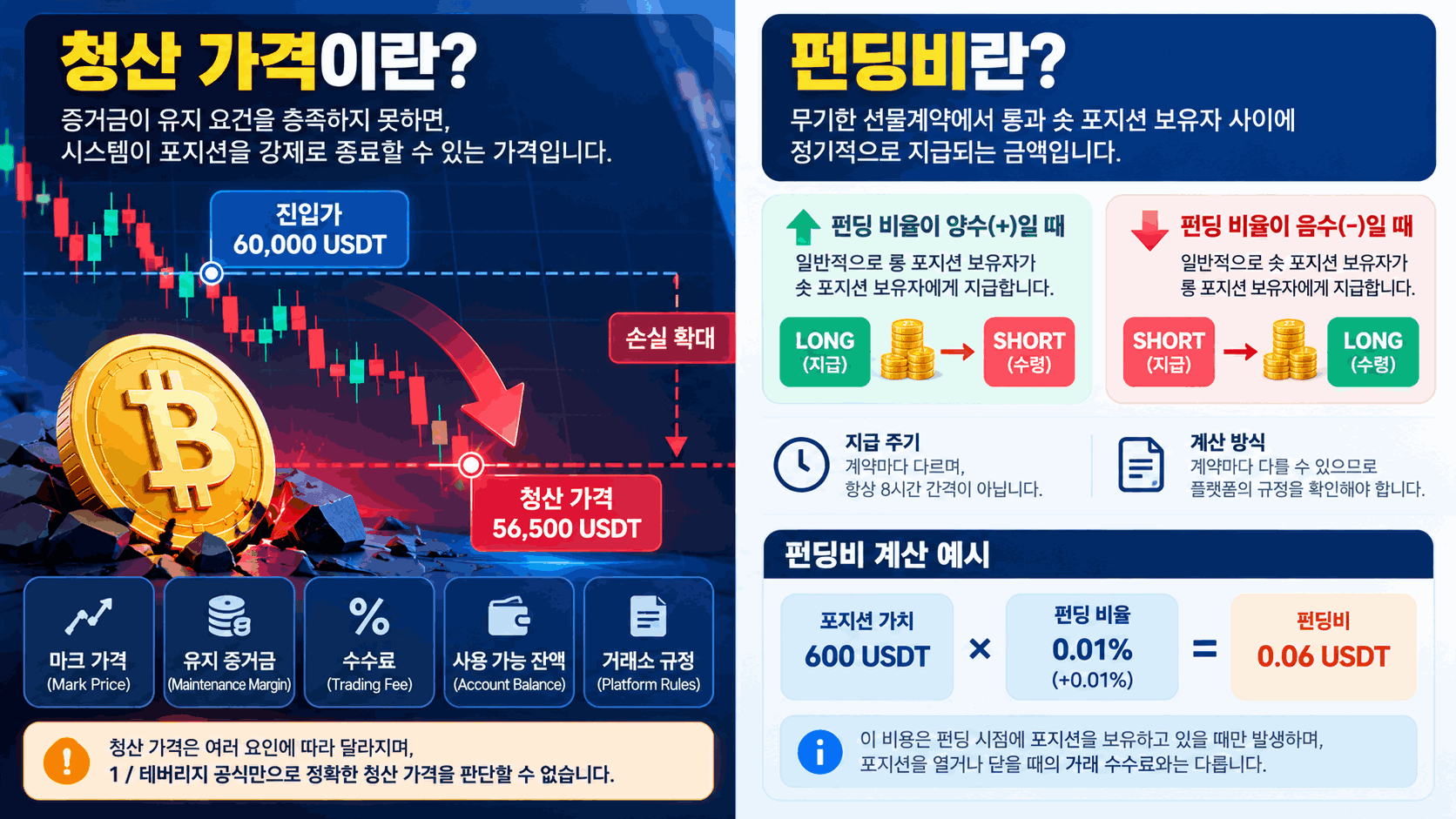
In Bitcoin futures trading, you must check the liquidation price and understand the cost according to the funding ratio and the payment structure between long and short positions.
Liquidation PriceSilver is a price area where the system can force a position to be closed when the margin no longer meets the holding requirements. This price varies depending on the mark price, maintenance margin, fees, available balance and regulations of each platform. 1 / 레버리지 The exact liquidation price should not be determined based on the formula alone.
Funding Feeis the amount paid regularly between long and short position holders in many perpetual futures contracts. If the Funding Rate is a positive number, longs usually pay to shorts, and if it is negative, shorts usually pay to longs. The cycle and calculation formula vary from contract to contract and are not always at 8-hour intervals.
Example assumptions: Assume the position value at the time of funding is 600 USDT and the funding rate is +0.01%. The corresponding cycle cost for the party with the payment obligation is approximately 600 × 0.01% = 0.06 USDT. Funding fees should not be confused with execution fees when opening or closing a position.
How to trade bitcoin futures
The procedure below describes a typical practice on an exchange that supports futures trading. Button names, available markets, and subscription terms vary by platform and region. Beginners are advised to practice first with a demo or paper trading before using real money.
Coin and Futures Market Selection
Switch to demo/mock investment mode and clearly check that it is not a live account.
Find the BTCUSDT pair or the corresponding BTC contract and check whether it is a perpetual futures contract or a contract with an expiration date.
Check whether the contract is USDT-M (USDT settlement) or Coin-M (coin settlement), quantity unit, quote unit, and position limit.
Check price data status, mark price, funding rate and trading conditions before creating an order.
The examples in this article are based on BTCUSDT linear perpetual futures where PnL is calculated in USDT. The formula may be different for products that use inverse linear contracts or special contract sizes.
Leverage settings
If the system supports it, select margin mode and set the leverage multiplier that suits your practice goals. You should not increase leverage just because the platform allows it. Check the nominal position value and expected margin before confirming.
position value | leverage | theoretical margin |
600 USDT | 2x | 300 USDT |
600 USDT | 5x | 120 USDT |
600 USDT | 10x | 60 USDT |
600 USDT | 20x | 30 USDT |
In the table, the position value is fixed at 600 USDT. If the contract quantity for the same position does not change, changing leverage mainly changes the initial margin and return on margin and never increases the PnL itself.
Select long/short and submit order
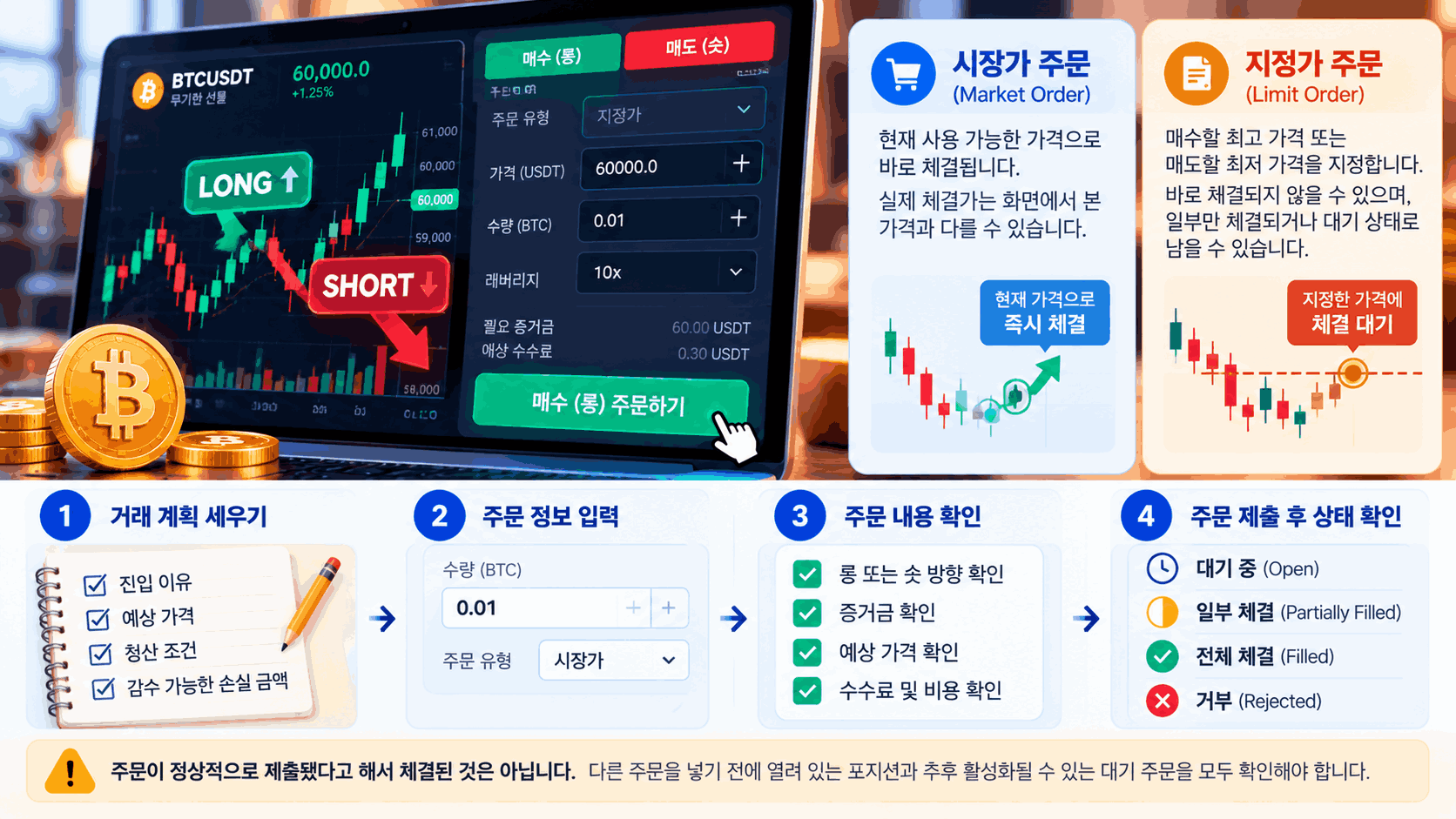
It shows the basic procedures of Bitcoin futures trading, from selecting long and short positions to submitting orders and checking execution status.
After deciding on the direction and size of the transaction, select the order type. Market orders are executed at the available price, so the actual execution price may differ from the price seen on the screen. Limit orders specify the highest price to buy or the lowest price to sell, but may remain pending, partially filled, or not filled at all.
Record the reason for entering the position, the expected price, the exit conditions, and the amount of loss you can tolerate in the exercise.
Enter quantity or position value and select market price/limit price.
Before sending an order, check whether it is long or short, margin, estimated price and cost.
After submitting an order, check the status of waiting, partial execution, full execution, or rejection. Only positions that have actually been concluded are managed.
Just because an order has been submitted properly does not mean it has been concluded. Before placing another order, you should check all open positions and pending orders that may become active later.
Set stop loss and take profit
Stop Loss (SL)is an order or condition for closing a position when the price moves unfavorably, and Take Profit (TP) is used to confirm profits according to the plan. Depending on the exchange, trigger conditions may be based on Last Price, Mark Price, or Index Price. The trigger price does not guarantee the actual execution price.
Learning example: Assume you open a 0.01 BTC long position at 60,000 USDT and plan to take a stop loss at 59,000 and a take profit at 62,000. If it closes exactly at 59,000, the loss before fees is (59,000 − 60,000) × 0.01 = −10 USDT, and the profit before fees at 62,000 is 20 USDT. Check Reduce-only/Close Position mode, if offered, to ensure liquidation orders do not unintentionally open opposing positions.
How do you calculate the profit or loss of Bitcoin futures trading?
The PnL before cost of a BTCUSDT linear contract varies depending on the BTC quantity in the position and the difference between the entry and exit prices. If the position quantity is the same, leverage does not enter directly into the PnL formula.
position | PnL formula before fees |
long | (End price − Entry price) × BTC quantity |
short | (Entry price − End price) × BTC quantity |
Margin ROI (approximation) | PnL before commission / initial margin × 100% |
Consistent example: open a 0.01 BTC long position at 60,000 USDT and close it at 63,000 USDT. The position value upon entry is 600 USDT, and if you select 10x leverage, the theoretical margin is 60 USDT. PnL before commission is (63,000 − 60,000) × 0.01 = 30 USDT, which is approximately 50% of the 60 USDT margin. Even if the same amount is traded with 5x leverage, the PnL is the same at 30 USDT, but the theoretical ROI is 25% compared to the margin of 120 USDT.
Assume that the entry and exit fees are each 0.05% of the transaction value. The entry fee is 600 × 0.05% = 0.30 USDT, and the exit fee is 630 × 0.05% = 0.315 USDT. PnL after two fees excluding funding is 30 − 0.30 − 0.315 = 29.385 USDT. This is an assumed fee for illustrative purposes only and is not a specific exchange rate.
Unrealized PnL fluctuates while the position is open, while Realized PnL is recognized for the portion that is closed. Fees and funding may have already been deducted on the Closed PnL report, but the unrealized PnL on screen may not include these amounts. You should check the definition of each indicator in the platform.
Precautions when trading Bitcoin futures
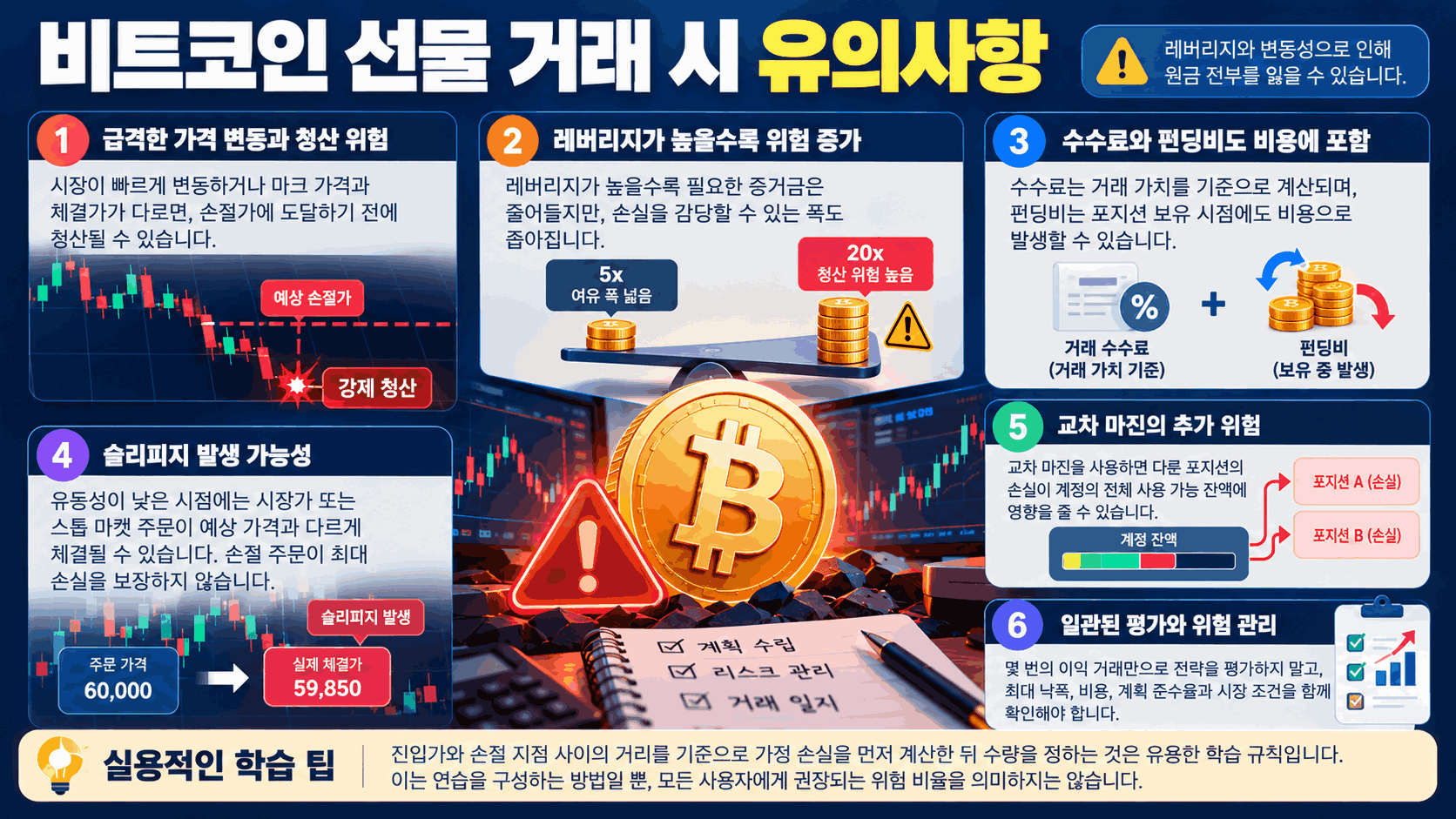
In Bitcoin futures trading, major risks such as leverage, forced liquidation, fees, and slippage must be identified.
If the market fluctuates quickly, there is a difference between the mark price and the execution price, or the order settings are inappropriate, the order may be liquidated before the price reaches the stop loss price.
The higher the leverage, the smaller the margin required for the same position value, and generally the narrower the range of losses you can afford. The actual liquidation price must be confirmed at the exchange.
Fees are calculated based on transaction value according to product regulations and cannot be assumed to apply only to margin. Funding is also affected by the timing of position holding.
In particular, slippage may occur if a market or stop market order is executed at a time when liquidity is low. Stop loss orders do not absolutely guarantee the maximum loss amount.
Cross margin may also affect other available balances. The margin displayed on the screen should not be interpreted as the maximum loss amount under all conditions.
Don't evaluate a strategy based on just a few profitable trades. Check maximum drawdown, cost, plan compliance rate and market conditions.
It is a useful learning rule to first calculate the assumed loss based on the distance between the entry price and the stop loss point and then determine the quantity. This is just a way to structure the exercise and does not imply a recommended risk ratio for all users.
How to practice futures trading with mock investing
Paper Trading allows beginners to practice long/short manipulation, margin tracking and strategy evaluation without putting real money into mock orders. However, simulated systems may not fully reflect actual liquidity, slippage, funding, or psychological effects of real trading.
Choose a demo platform that supports the type of BTC futures contract you want to practice on and check its features before starting. ASUNMO can be used to practice simulated trading operations that the platform actually supports, but it should not be assumed to replicate all futures rules of each exchange.
virtual moneySet consistently. For example, set it to 1,000 USDT, and if you cannot adjust the balance, limit the amount of usage in your journal.
Set a simple practice task. Observe BTCUSDT and determine the reason for long/short selection, quantity, leverage, stop loss and take profit.
Submit your order and check the execution status. Record execution price, display fee, margin changes and remaining pending orders.
Calculate the PnL before cost directly and compare it with the PnL on the screen. Find the cause of differences due to execution price, fees, funding or mock rules.
After each practice section, at least 10 trades are evaluated for plan adherence, manipulation mistakes, maximum drawdown and cost. 10 cases is only an illustrative exercise standard and is not sufficient to demonstrate the effectiveness of the strategy.
Transaction Journal Entry | What to record |
Before ordering | Date/time, BTCUSDT, long/short, reason for selection, expected entry price |
setting | Leverage, Isolation/Crossing, Quantity, SL/TP |
execution | Execution price, order status, commission/funding |
result | PnL before and after cost, maximum drop |
evaluation | Did you follow the plan? Were there any operating errors? What needs to be fixed? |
The goal of simulated investing is not to make virtual balances as large as possible, but to understand contract mechanisms, find errors, and maintain evaluable procedures. Demo results do not guarantee returns using real funds.
Frequently Asked Questions
1. Should beginners use high leverage in Bitcoin futures trading?
no. Available leverage multipliers vary depending on the contract and platform. Learners can use low multipliers or just learn the mechanics with a demo account before deciding to use real funds.
2. If I open a long Bitcoin futures position, do I own BTC?
This is not necessarily the case. In most derivatives contracts settled in cash or USDT, traders only hold a contract position and do not directly own the corresponding amount of BTC.
3. Can liquidation be avoided by setting a stop loss price?
no. If the market fluctuates significantly, your order may not trigger as expected or may be filled at a different price. You should check the trigger price, order type and liquidation level on the platform.
4. Is the funding fee always paid every 8 hours?
no. Funding cycles and calculation methods vary by contract and exchange. Funding fees can be paid or received depending on the sign of the funding rate and the direction of the position.
5. Is it possible to withdraw profits when practicing Bitcoin futures with virtual funds?
Simulated profits cannot be withdrawn like real trading funds. If there is a cash reward contest, the rewards are subject to separate program rules and are not profits from the demo account.
To begin systematically trading Bitcoin futures, you must first accurately understand long/short positions, contract value, margin, PnL calculation method, and liquidation mechanism. Practicing with virtual funds, checking order status, and recording costs can help you catch manipulation errors before considering real trades.
How to trade bitcoin futuresTo learn, you must first understand long and short positions, leverage, margin, and liquidation structure. When trading, it is important to check order execution status and costs, and evaluate profit and loss and risk together. Before using real funds, you can practice the trading process using the features supported by a mock trading platform such as ASUNMO.
0 Comments
No comments yet. Be the first to share your thoughts.