



Long is a position that generates profits when the price rises, and short is a position that generates profits when the price falls. However, accurately predicting the direction does not necessarily result in a net profit. Actual results will vary depending on execution price, position size, and various costs.
This article takes BTCUSDT as an example and explains how to calculate long and short profits and losses for linear contracts that use USDT as margin and settlement currency. This formula cannot be applied directly to inverse linear contracts paid with coins.
(Risk Disclaimer: This article is for informational purposes only and is not investment advice.)
Key takeaways Long is a position that expects prices to rise, and short is a position that expects prices to fall. Long P&L Leverage allows larger positions to be operated with the same margin, thereby increasing both returns and risk of loss. Transaction fees, funding fees, and slippage affect actual net profit or loss. You must check the position size, stop loss criteria, and forced liquidation conditions before trading. |
What are cryptocurrency long and short?
What is a long position?
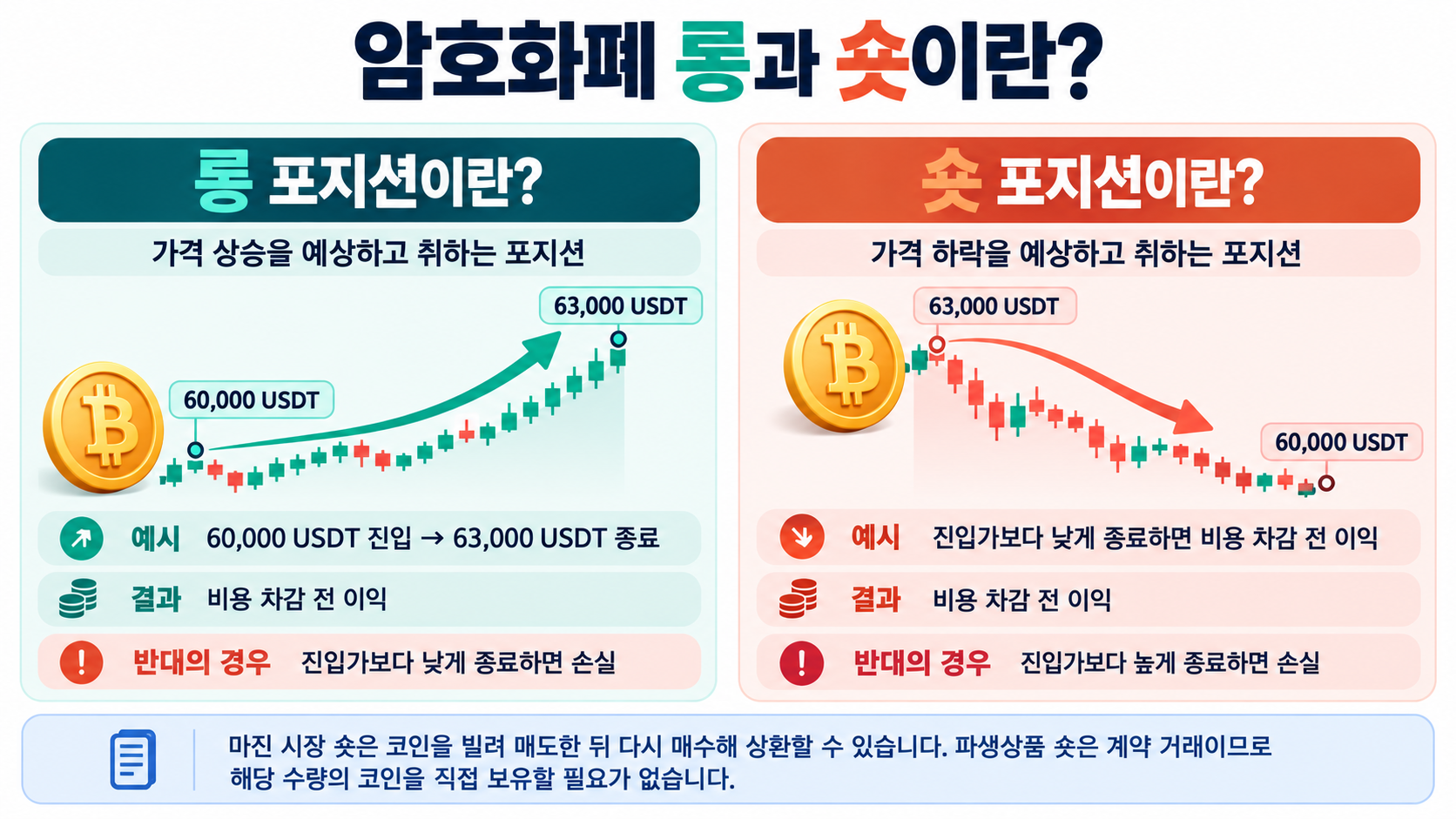
A long position is a position taken in anticipation of a price rise. If you close a position at a price higher than the entry price, you will make a profit before deducting costs, and if you close the position at a lower price, you will incur a loss.
For example, if you open a BTC long position at 60,000 USDT and close it at 63,000 USDT, the price difference is a favorable transaction.
What is a short position?
A short position is a position taken in anticipation of a price decline. If you close a position at a price lower than the entry price, you will make a profit before deducting costs, and if you close the position at a higher price, you will incur a loss.
Two methods must be distinguished. Short trading in the margin market may involve borrowing coins, selling them, and then buying them back to repay them. On the other hand, short derivatives are a method of trading contracts, so users do not need to directly hold the corresponding amount of coins.
What is cryptocurrency long and short?
Long vs short comparison
standard | long | short |
market outlook | price rise | price drop |
Profit before expenses terms | End price > Entry price | End price < Entry price |
Loss conditions before expenses | End price < Entry price | End price > Entry price |
Derivatives position exit direction | Sell to end the long | Buy and exit short |
Long and short refer to position direction, not holding period. Long positions can be closed in a matter of minutes, and short positions can be held for several days if product structure and margin requirements allow.
How to Calculate Long Position Profit and Loss
The USDT linear contract is calculated as follows:
Long P&L = Coin Quantity × (End Price − Entry Price) |
If the position has not been closed yet, the base price used by the platform to calculate profit and loss (P&L) is substituted instead of the closing price. P&L is an indicator of profit and loss of a cryptocurrency investment or trading position. This result is an unrealized profit or loss and fees may not yet be reflected.
Bitcoin long position profit/loss calculation example
Assume you open a 0.01 BTC long position at 60,000 USDT/BTC. The initial position value is 600 USDT.
Position termination situation | calculate | Profit and loss before expenses |
BTC rises to 63,000 USDT | 0.01 × (63,000 − 60,000) | +30 USDT |
BTC falls to 57,000 USDT | 0.01 × (57,000 − 60,000) | −30 USDT |
The above calculation is when all 0.01 BTC is ended at the suggested price. If the transaction was completed multiple times, the appropriate average transaction price must be used, and if only a partial transaction was completed, only the completed quantity is calculated.
How to Calculate Short Position Profit and Loss
Short positions calculate the direction of price differences in the opposite direction.
Short P&L = Coin Quantity × (Entry Price − Exit Price) |
Bitcoin short position profit and loss calculation example
Assume you open a 0.01 BTC short position at 60,000 USDT/BTC.
Position termination situation | calculate | Profit and loss before expenses |
BTC falls to 57,000 USDT | 0.01 × (60,000 − 57,000) | +30 USDT |
BTC rises to 63,000 USDT | 0.01 × (60,000 − 63,000) | −30 USDT |
Both examples show that when the quantity and price difference are equal, the profit from one position equals the loss before costs of the other position. Just because the price falls does not mean that all short positions automatically make a profit. The exit price must be sufficiently lower than the entry price to offset the costs.
How will profit and loss change when leverage is applied?
If you use leverage You can operate a position value greater than the initial margin. The simplified relationship is as follows.
Initial position value ≈ initial margin × leverage |
One thing to note is that if the position quantity is the same, the profit and loss amount itself will not automatically increase even if the leverage is increased. In the USDT linear contract, the profit or loss due to price fluctuation is calculated as the difference between the coin quantity and the entry and exit price, and the calculation result is not multiplied again by the leverage.
For example, if you open a 0.01 BTC long position at 60,000 USDT and close it at 63,000 USDT, your profit before expenses is 0.01 × (63,000 − 60,000) = 30 USDT.
Regardless of whether the leverage is 1×, 5×, or 10×, the quantity and price difference of 0.01 BTC are the same, so the profit is 30 USDT. Assuming the position is not liquidated, if you close at 57,000 USDT, the loss in all three cases is 30 USDT.
The following is an example of opening positions with 1×, 5×, and 10× leverage, respectively, using the initial margin of 100 USDT. Excluding commissions and funding costs, it is assumed that the position has not been forced to liquidate.
leverage | position value | Price moves 2% in a favorable direction | Price moves 2% in an unfavorable direction | Profit/loss ratio compared to margin of 100 USDT |
1× | 100 USDT | +2 USDT | −2 USDT | ±2% |
5× | 500 USDT | +10 USDT | −10 USDT | ±10% |
10× | 1,000 USDT | +20 USDT | −20 USDT | ±20% |
The reason the profit or loss increases in the table is because the position size increases.
Conversely, if the position value is fixed at 1,000 USDT, the profit before costs is 20 USDT at any leverage when the price moves 2% in a favorable direction. The theoretical margin required for 1×, 5×, and 10× is 1,000 USDT, 200 USDT, and 100 USDT, respectively, and the return on margin is 2%, 10%, and 20%, respectively.
Costs that Affect Actual Profit
Beginners often miss the costs incurred by only looking at the difference between the entry and exit prices. For this reason, although it is displayed as profit on the trading screen, the actual profit or loss of the account may be negative after the position is closed.
transaction fee
Transaction Fee Calculationincludes the following items:
Transaction fee = Quantity of concluded coins × Conclusion price × Commission rate |
Quantity of coins concluded: This is the amount of assets corresponding to the actually concluded part of the contract. Example: 0.01 BTC.
Closing Price: This is the price at which the transaction was actually concluded.
Commission rate: This is the rate that the exchange applies to the account and transaction type. Example: 0.05% = 0.0005.
Fees are charged on the total transaction value, not on the margin. For example, if you apply 10× leverage to a position with a value of 600 USDT, the initial margin is only required to be about 60 USDT. However, if the commission rate is 0.05%, the entry fee is not 60 × 0.05% = 0.03 USDT, but 600 × 0.05% = 0.30 USDT.
Example: 0.01 BTC long trade from 60,000 USDT to 63,000 USDT
Assume that the entire position opens at 60,000 USDT/BTC and ends at 63,000 USDT/BTC, and a 0.05% commission is applied in both directions.
Transaction value at entry: 0.01 × 60,000 = 600 USDT
Entry fee: 0.01 × 60,000 × 0.05% = 0.30 USDT.
Exit fee: 0.01 × 63,000 × 0.05% = 0.315 USDT.
Total transaction fee: 0.615 USDT.
Since the Bitcoin price was higher when the position was closed, the transaction value increased from 600 USDT to 630 USDT, the exit fee is higher than the entry fee even if the quantity is the same at 0.01 BTC.

Costs that Affect Actual Profit
Funding Fee and Funding Rate
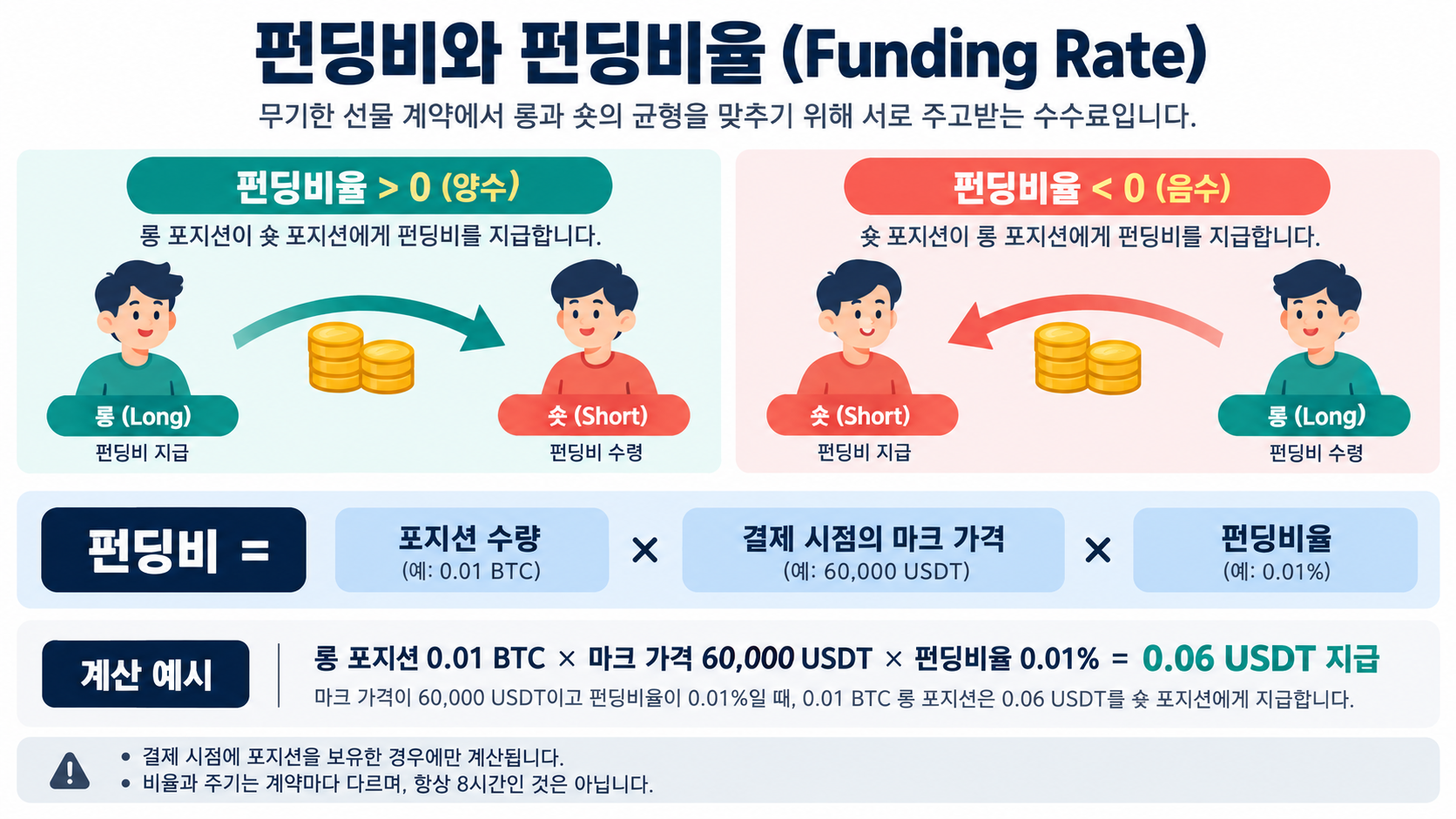
Funding feearises from a mechanism whereby both sides of a perpetual contract exchange payments so that the contract price follows the spot market price. The funding rate is the applied rate, and the funding fee is the amount actually paid or received.
If the funding ratio is positive (>0), long position holders generally pay the funding fee to short position holders.
If the funding ratio is negative (<0), short position holders generally pay the funding fee to long position holders.
Funding fee = Position quantity × Mark price at time of settlement × Funding rate
Funding fees are calculated only if the position is maintained at the time of settlement. Rates and payment cycles may vary from contract to contract, so do not always assume 8 hours.
For example, if the long position is 0.01 BTC, the mark price is 60,000 USDT, and the positive funding rate is 0.01%, 0.06 USDT is paid in that round.
Funding fee and funding rate
Slippage
Slippage is the difference between the price you intended to order and the price actually entered into the order book. Altcoins where the market suddenly fluctuates significantly or has low liquidity market orderThis often happens when trading. (You can add a link to an article related to what is an altcoin)
For example, if you tried to close a 0.01 BTC long position at 63,000 USDT, but the actual closing price was 62,950 USDT, your profit before expenses would be reduced by 0.50 USDT.
Common mistakes beginners make in long and short trading
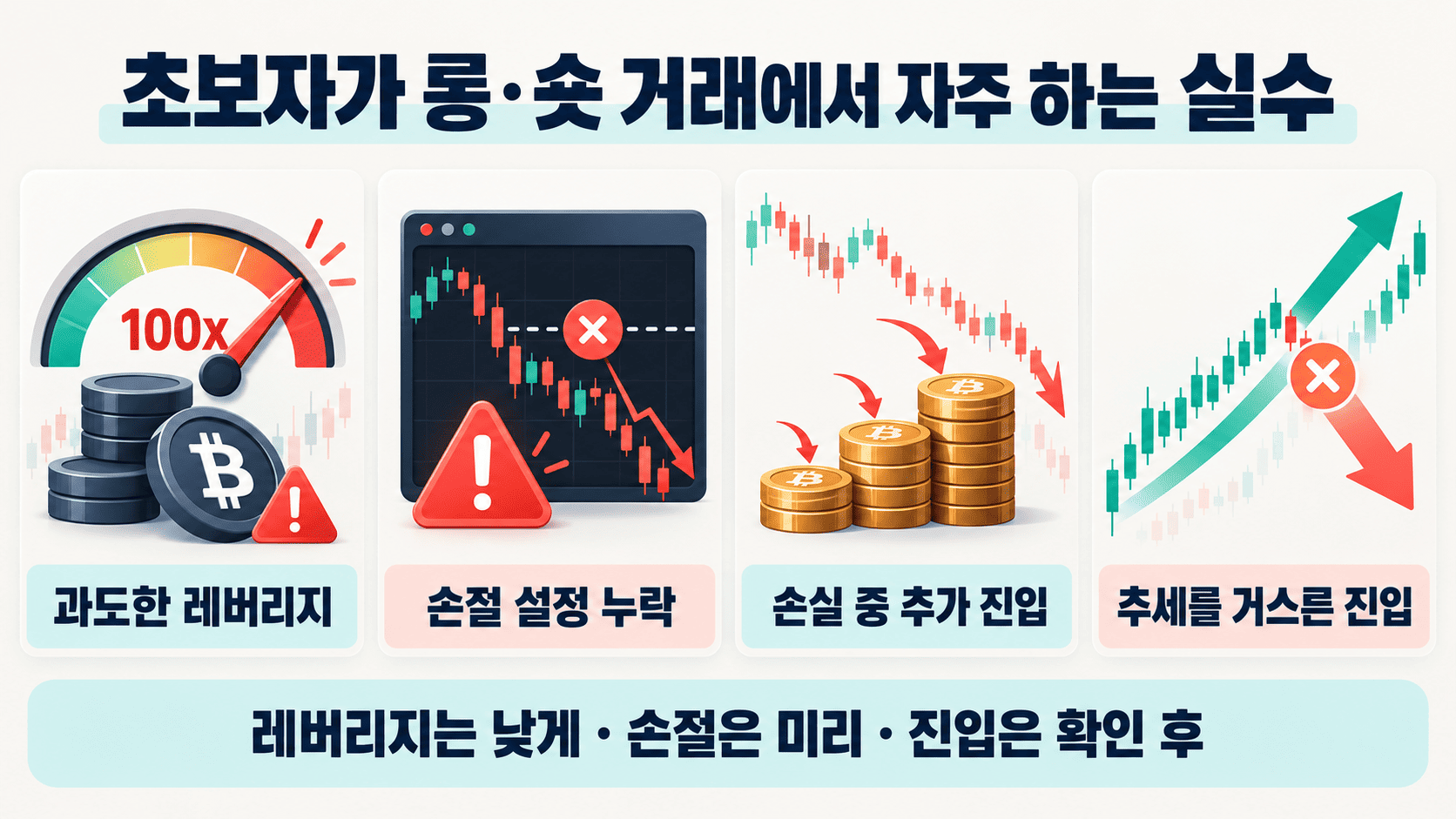
Excessive leverage (50×~125×): If leverage is too high, the price margin until forced liquidation is greatly reduced. Depending on the product and exchange conditions, a position may be forced to be liquidated if the price moves even 0.5 to 1% in the opposite direction.
Do not set a stop-loss order: Trading without a pre-determined stop loss point reduces your means of controlling losses when the market moves unfavorably.
Additional entry while holding on to losses (Martingale): If a loss occurs in a position, add more margin or make additional purchases or sales. average unit priceThere is a trader who adjusts . If the cryptocurrency market moves significantly in one direction, this method can greatly increase the risk of losses and forced liquidation.
It is also a common mistake to open a short position excessively when the market is showing a parabolic upward trend, or to open a long position without a confirmation signal of fund flow in a situation where a strong selling trend continues.
Common mistakes beginners make in long and short trading
Frequently Asked Questions
1. What is long-short strategy?
Long-Short Strategy is a two-way investment technique that takes a long position in assets whose prices are expected to rise and a short position in assets whose prices are expected to fall.
2. Is it necessary to use high leverage for long and short trading?
no. Long and short indicate the direction of the position, and leverage is a separate factor. Whether you can choose 1× or another multiple depends on the product conditions.
3. How do I check the long/short ratio?
Long/short ratios can be checked on data platforms or derivatives exchanges.
CoinGlass: If you select Bitcoin, Ethereum, or a coin to check, you can see the long/short ratio by exchange and time period.
Check the appropriate long and short indicators in the Binance Futures: Trading Data menu. Depending on the platform, account-based rates and top traders' position-based rates can be provided separately.
Cryptocurrency long is a position that expects the price to rise, and short is the position that expects the price to fall. Actual profits and losses are affected not only by entry and exit prices, but also by leverage, transaction fees, funding fees, and slippage. Therefore, you must check the profit and loss structure and forced liquidation conditions before trading and set the position within an acceptable range. This content is for informational purposes only and is not an investment recommendation.
0 Comments
No comments yet. Be the first to share your thoughts.