



When looking for a pension savings fund securities company recommendation, you should not look at just the minimum commission number, but also compare investment products, trading frequency, holding period, and account management convenience. Even if online transaction fees are low, the ETF itself may incur separate fees and other costs, and event fees may be limited by applicable account or period. It is reasonable to set standards that suit your investment method and then check the latest costs under the same conditions.
Costs to know before choosing a pension savings fund securities company
The costs experienced in a pension savings account are largely divided into transaction costs paid to securities firms and costs incurred within investment products. Since the two items have different charging entities and confirmation locations, they are not combined and compared. ETFs may incur fees and expenses of the fund itself and securities company trading commissions. For public offering funds, front-end and back-end sales fees and sales fees may vary depending on the class.
cost item | What to check | Where to check |
ETF/REIT trading fees | Online/offline rates, account type, preferential treatment | Latest commission information for securities companies |
ETF total fees and other expenses | Operation, trust, office management costs and other costs | ETF product information/investment prospectus |
Fund compensation/fees | Sales remuneration, first, second, repurchase fees, class | Fund prospectus/disclosure |
Event preferential treatment | Application Requirements, Eligible Accounts, Coverage Period, Post-Termination Rates | Event detailed terms and conditions |
Account-related costs and restrictions | Separate management costs, tradable products, transfer procedures | Account terms and conditions/pension information |
In particular, you should check which transactions, which accounts, and for how long the phrase ‘free of commission’ applies. Also check whether related agency costs or other transaction costs are listed separately. Do not determine the actual cost based on the advertising text alone, but write down the date of inquiry and applicable conditions.
How to compare pension savings fund fees
Pension savings fund securities company fee comparisons are based on the same date, transaction channel, and same product type. It is not a fair comparison if one company uses the direct account online rate and another company uses the branch account rate as the standard. In the comparison table, write down the basic fee and event fee separately, and also record the normal rate after the event ends.

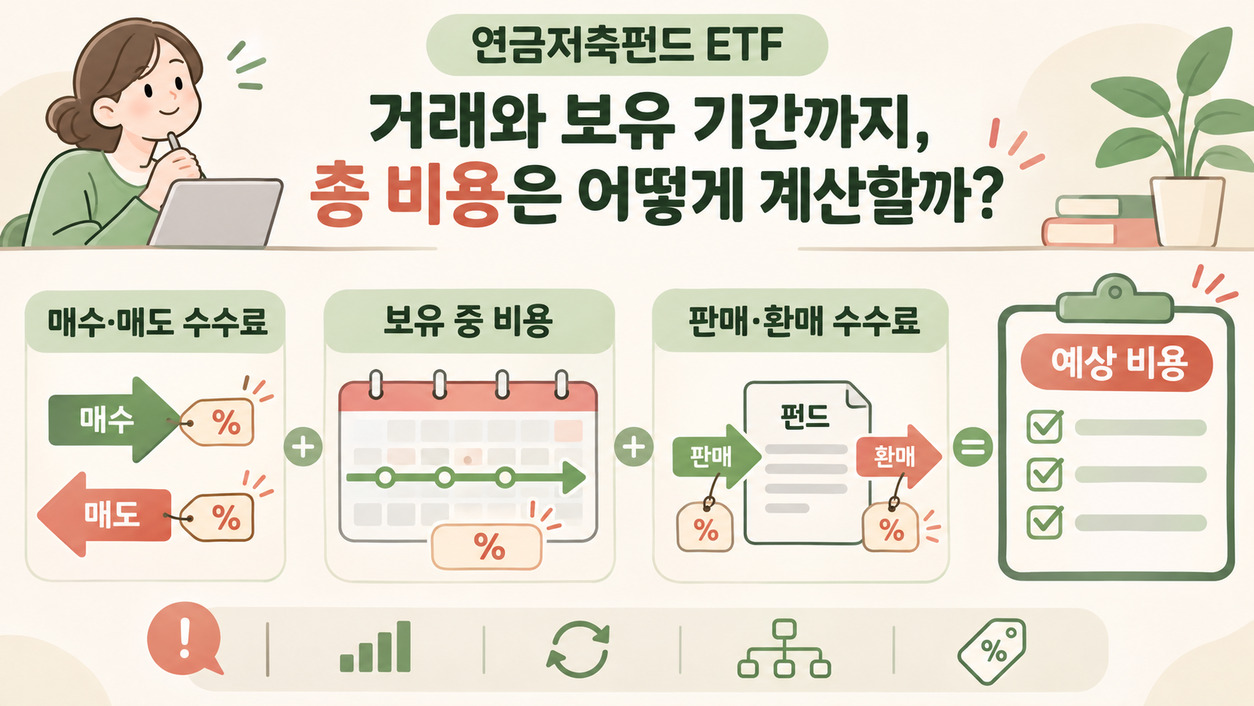
Total cost is calculated based on transaction method and holding period.
If you buy and sell ETFs frequently, recurring transaction fees when buying and selling become important. On the other hand, if you focus on long-term holding, you need to consider not only the number of transactions, but also the fact that you will bear the total cost of the product and other costs over a long period of time. The simplified check equation is as follows.
Estimated cost = Buy/sell transaction fees + Product maintenance/other costs during the holding period + Applicable fund sales/redemption fees
Actual costs vary depending on order amount, number of transactions, product structure, and preferential terms. This formula is a check standard to ensure that comparison items are not omitted, and is not a calculation that guarantees future rates of return or actual charges.
Choosing a securities company that suits your investment type
investment type | Criteria to check first | Check when choosing |
Buy and sell ETFs directly | Availability of desired ETFs, online fees, order screen | Check the rates for the actual account type and ordering channel you will use |
Regular long-term savings | Width of product selection, total compensation/other costs, convenience of accumulation | Don’t just look at trading fees, but also compare long-term holding costs. |
Focus on public offering funds | Fund lineup, compensation by class, redemption conditions | Comparison of classes and sales commission structures of the same fund |
Transfer existing account | Goods that can be transferred, restrictions on buying and selling during transfer, processing procedures | Check the balance and product processing schedule before and after transfer with the company. |
Based on this standard, it is difficult to select a single securities company that recommends a pension savings fund that works for everyone. Investors who value low online transaction fees and those who want to compare various fund products may have different priorities. Therefore, even if you refer to the recommendations of pension savings fund securities companies, you must re-check the conditions applicable to the product and account type you will actually purchase.
Checklist for creating a comparison table for each securities company
Compare items | What to record |
Account type | Real account conditions such as new/existing, direct/branch, etc. |
Investment products | Availability and product type of the ETF/fund you wish to purchase |
transaction fee | Buying/selling rates, online/offline distinction, separate costs |
product cost | ETF total fees/other expenses or fees by fund class |
event | Application status, eligibility, period, excluded transactions, regular rate after termination |
Account Management | App usability, customer support, pension initiation/transfer information |
Reference date for inquiry | Date of confirmation of fee schedule and product information |
Since commission standards and events may change for each company, the standard date is left in the comparison table. When checking cost information, refer to the latest fee information and product descriptions and disclosures on the securities company website. Pension savings fund fees must be recorded separately from transaction costs and product internal costs in order to properly compare the conditions of different products or companies.
Frequently Asked Questions
1. Which securities company has the lowest pension savings fund fees?
It is difficult to conclude that one securities company is the cheapest for all investors. The actual burden will vary depending on the account type, transaction channel, number of orders, products purchased, and whether events are applied. Compare the latest rates based on the account conditions you will use.
2. Is the total fee for ETFs the same as securities company trading fees?
different. ETF total fees and other expenses are costs incurred in the process of operating the product, and trading commissions are costs applied when buying and selling ETFs through securities firms. You must check both items separately.
3. Will event fees still apply?
Each event has different targets, application procedures, application periods, transaction channels, and exception conditions. Also check the fees and additional costs that apply after termination. Read the terms and conditions to see if benefits are confirmed just by signing up or applying for an event.
Good choices don't end with finding the lowest number. I need to check whether there is an ETF or fund I want to invest in, what fees are applied to the actual account, what the long-term holding costs are, and what the account transfer procedures are. When comparing recommended pension savings fund securities companies, calculate the total cost using the same base date and conditions, and check the company's latest information again before final opening.
0 Comments
No comments yet. Be the first to share your thoughts.