



What is virtual money in mock investment? Refers to simulated funds or assets used for trading practice. Understanding how to use it and its limitations will help you more accurately determine the results of your practice.
(Note: This article is for reference only and does not constitute investment advice.)
Summary of key points Simulated investment virtual assets refer to funds or assets for trading practice that have no real value. With simulated assets, you can practice ordering methods, trading strategies, stop loss criteria and money management methods. Mock balances generally cannot be withdrawn or transferred to personal wallets and are not converted to real assets. Since the execution price, cost, and investment sentiment may differ from the actual transaction, the transaction process and compliance with principles should be evaluated together rather than profit. |
What is virtual money in mock investment?
Concept of mock assets and virtual balances
Simulated assets are funds or assets recorded by the system in a mock investment account and used for trading practice. It may appear as USD, USDT, BTC, etc., but it is not an asset actually issued to the user.
In this article, ‘simulated investment virtual funds’ refers to funds for practice purposes and does not refer to virtual assets with actual value. Bybit also describes demo trading as an environment to learn how to use the platform and test strategies with simulated assets.

What is the difference between simulated assets and actual investment assets?
division | mock assets | actual investment assets |
funding source | mock funds | actual funds or assets |
transaction | Processing in mock system | executed in the market |
loss | Decreased demo account value | decline in real assets |
Withdrawal | Generally no withdrawals possible | Available subject to service terms |
Referring to actual market prices does not convert your simulated balance into real funds.
To check not only the nature of the funds, but also the difference in order execution, cost, and psychological burden. 7 differences between mock investment and actual investment: Things to check before actual investmentIt is recommended to read .
Simulated investment virtual asset meaning
Practice trading procedures without real capital
The first role of a simulated investment virtual fund is to provide a practice environment. You can practice buying and selling, submitting and canceling orders, and checking your portfolio without incurring any actual capital loss from these trades.
ASUNMO, a mock investment platform, helps you practice market orders, limit orders, and stop orders in paper trading. This will help you learn how to enter order information before actual trading.
To better understand how each order works and the possibility of it being unfilled or partially filled Summary of the difference between limit and market orders and how to use stop ordersIt is recommended to read .

Test your strategies and learn how to manage your money
With simulated funds, you can also check:
Transaction size relative to total funds
Expected loss when stop loss threshold is reached
Compliance with entry and exit plans
Rather than just looking at the final profit, it's a good idea to evaluate your practice by recording the reasons for your trades and their results.
How to set practice funds, loss limits and recording standards for each transaction 7 things you need to know before starting mock investingYou can check in more detail here.
How to Use Demo Assets for Trading Practice
Set up a practice fund and select assets to trade
Before you start, make sure your account is in demo or paper trading mode. Next, check the items below.
Amount of simulated funds paid out
Is it possible to adjust the size of the funds?
Supported assets and transaction types
How the platform calculates fees and profits and losses
In coin mock investment, you can practice buying or selling coins or trading mock contracts depending on the platform. If you can adjust the size of your fund, set it to be similar to the size you want to practice managing.
The procedure for checking your virtual balance and executing your first order in ASUNMO is: Aseonmo Beginner’s Guide: Getting Started with Mock TradingYou can check it here.
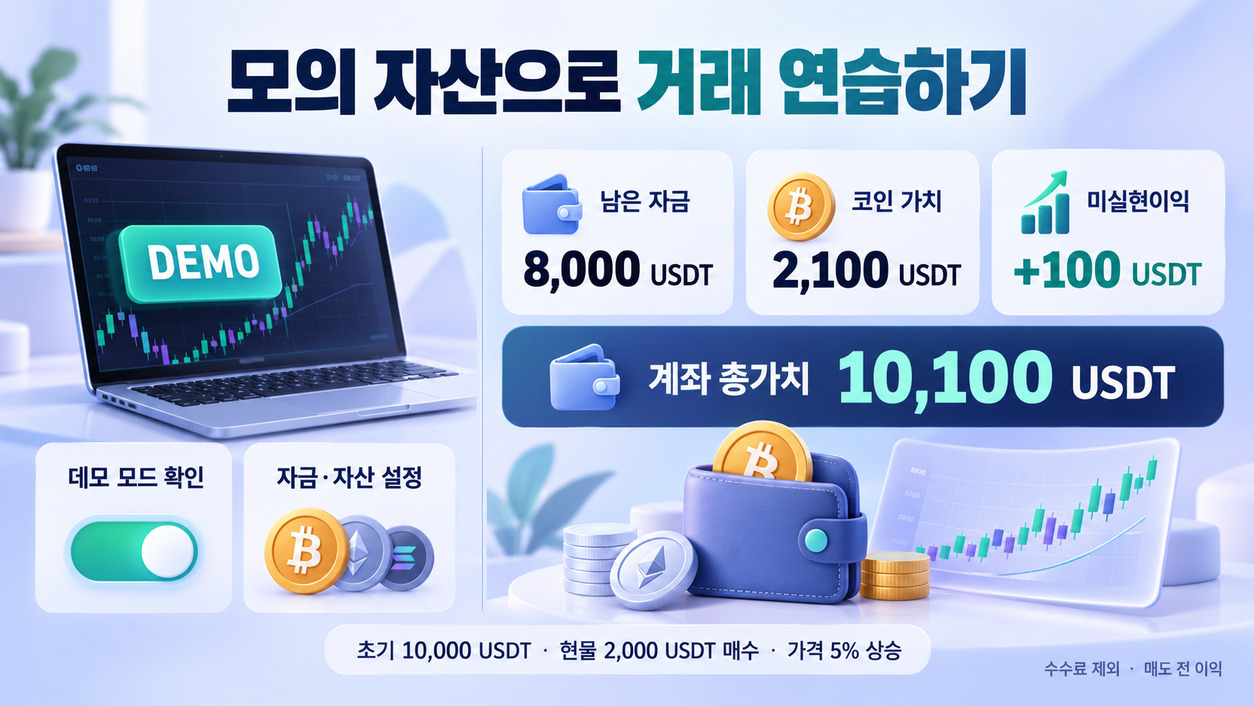
Check simulated investment balance and profit and loss
When checking your virtual investment balance, you need to distinguish between available funds, the value of your assets, and unrealized gains and losses.
Example assumption: You have 10,000 USDT in simulated funds, and buy 2,000 USDT worth of coins in cash without using leverage and excluding fees.
Funds remaining: 8,000 USDT
Coin price rises 5%: coin value 2,100 USDT
Total account value: 10,100 USDT
Sell all at that price: fund balance 10,100 USDT
The profit of 100 USDT before selling is unrealized and may vary depending on the price.
To calculate account rate of return after reflecting realized and unrealized gains and losses and expenses: How to calculate simulated investment returns: Profit and loss formula and rate of return exampleIt is recommended to read .
Two limitations to be aware of when using virtual funds
Execution prices and costs may differ from actual transactions.
There is no guarantee that mock investments will completely reproduce actual trading conditions. Interactive Brokers advises that the PaperTrader system has limited quote book depth and that some order types may behave differently than in a live account.
Before evaluating your results, check the following items:
Is there a delay in pricing data?
Transaction fee and slippage reflection method
Funding fee and margin simulation reflection method for perpetual contract

The psychology of using virtual funds is different from real funds
You can easily increase your trade size or ignore the stop loss rule because you won't lose any real money. Resetting your balance every time a loss occurs also reduces the continuity of your practice results.
To evaluate your progress more clearly, keep the same bankroll size throughout the test period, record all losses, and review your decisions. Simulated investment returns do not guarantee actual performance.
Understanding what simulated funds are allows you to practice trading for your purposes. When practicing at ASUNMO, focus on money management and process evaluation rather than just looking at profits.
Good article to read together
7 popular mock investment apps in the Korean market
Overseas futures mock investment method and site selection criteria
Aseonmo Market Standard: Understanding the rules of the game and preparing for a strategy test
Frequently Asked Questions
1. Can I withdraw simulated assets for real funds?
This is generally not possible. Bybit informs you that the funds in your demo account are simulated assets and cannot be withdrawn. If there is a separate rewards program, you should check the terms and demo balance should not be considered paid funds.
2. What should I do if I exhaust my mock investment balance?
Check your ability to receive additional funds or reset them according to platform regulations. Before continuing with the practice, it is a good idea to save your trading history and identify the reasons for your losses to avoid repeating the same mistakes.
3. Does coin mock investment use real coins?
no. The BTC or USDT displayed in your demo account is for practice purposes only. Buying coins in that environment does not mean you will have actual coins that can be transferred to your personal wallet.
What is a simulated investment virtual asset? These are practice funds or assets that have no real value and cannot be withdrawn or transferred to a personal wallet. Using it, you can practice ordering methods, trading strategies, and money management processes without losing any real capital. However, the execution price, commission, slippage, etc. may be reflected differently from the actual market, and the psychological burden of managing real funds is difficult to completely reproduce. Therefore, it is more important to check whether trading principles have been followed and to consistently record the decision-making process than the simulated profits themselves.
0 Comments
No comments yet. Be the first to share your thoughts.