



Bitcoin Leveraged ETF is an exchange-traded fund designed to track the daily return of Bitcoin or a related index at a certain multiple. Unlike regular Bitcoin ETFs, 2x or 3x leveraged products aim for larger profits or losses based on daily price movements of the underlying asset.
Representative Bitcoin 2x leveraged ETFs include BITX, BITU, and BTCU, and each product may have different tracking targets and derivatives management methods. Additionally, due to the daily rebalancing structure, if held for a long period of time, the cumulative return will be different from simply multiplying the Bitcoin growth rate by the leverage multiple.
In this article, we look at the types of Bitcoin leveraged ETFs, the differences between 2x and 3x products, major tickers and return calculation methods, and risks to check before investing.
(Caution: This article is for educational purposes only and is not an investment recommendation or guarantee of profit.)
What is Bitcoin Leveraged ETF?
Bitcoin Leveraged ETF is an exchange-traded fund that utilizes leverage to seek daily return fluctuations greater than that of Bitcoin or related indices. Investors can buy and sell ETF shares through a securities account, just like when trading stocks.
The 2x leveraged ETF aims to rise by approximately 2% if the underlying index rises 1% during the day. Conversely, if the underlying index falls 1%, the ETF may fall by about 2%. Actual returns are affected by fees, tracking errors and other costs.
For example, assuming that the Bitcoin-related index rose 5% in one day, it would be as follows:
product type | Daily Target Return |
Bitcoin basic index | +5% |
2x Bitcoin Leveraged ETF | About +10% |
3x Bitcoin Leveraged ETF | approximately +15% |
This is a simple example that does not reflect costs. Because each ETF may track a different index, fund returns do not necessarily correspond to movements in the Bitcoin spot price.
Bitcoin leveraged ETFs should also be distinguished from Bitcoin spot ETFs. The basic structure of spot and futures ETFs is Differences between Bitcoin Spot ETF and Futures ETFIt is easy to understand if you read together.
Some leveraged funds use Bitcoin futures contracts, while others use swap contracts based on Bitcoin spot-related listed products.
How does a Bitcoin leveraged ETF work?
Bitcoin leveraged ETFs seek daily target returns by utilizing derivatives and adjusting market exposure. Because leverage is adjusted daily, cumulative returns over multiple days may differ from Bitcoin's overall rise or fall rate simply multiplied by the leverage multiple.
Daily return and leverage structure

The Bitcoin 2x leveraged ETF tracks the daily return of the underlying index by 2x, and both profits and losses can be magnified.
The key characteristic of leveraged ETFs is daily return. Most products aim to achieve a certain multiple of the index change rate seen during a single trading day.
Let's say an investor invests $1,000 in a 2x leveraged ETF and the underlying index rises 3% that day.
Initial investment: $1,000
Basic index increase rate: 3%
Target leverage multiple: 2x
ETF Target Return: 6%
Estimated investment amount: $1,060
Conversely, if the underlying index falls by 3%, the ETF's target loss rate becomes about 6%, and the investment amount decreases to about $940.
This calculation assumes that the fund achieves its target return exactly and incurs no expenses. The trading price of an ETF in the actual market may differ from the fund's net asset value (NAV).
The important thing is that a 2x ETF does not always guarantee a doubling of Bitcoin returns over the entire holding period. A distinction must be made between daily target returns and long-term cumulative performance.
Use of futures, swaps and other derivatives
Bitcoin leveraged ETFs can utilize futures, swaps, and other derivatives to secure market exposure appropriate to the target leverage.
A futures contract is a contract designed to trade an asset or settle it in cash at a set point in the future. ETFs that utilize Bitcoin futures can secure exposure to price fluctuations without directly holding Bitcoin. Bitcoin futures contract structure and trading principlesUnderstanding how futures-based ETFs operate will help you understand them.
Since futures contracts have an expiration date, the Fund can liquidate contracts with a closer expiration date and enter into new contracts with a further expiration date. This process is called rollover.
A swap contract is a derivative product that allows parties to exchange cash flows or profits based on an asset or underlying index. ETFs can use swaps to secure exposure to the leveraged returns of Bitcoin-related indices.
structure | characteristic | Risks to check |
futures based | Use of Bitcoin futures contracts | Maturity, rollover, futures and spot price differences |
swap based | Exposure to profits through swap contracts | Counterparty risk, financing costs |
General Spot ETF | Bitcoin spot price tracking | Price fluctuations, tracking errors, operating costs |
Not all Bitcoin leveraged ETFs use the same structure. Investors should check the underlying assets and management method in each fund's investment prospectus.
Differences between 2x and 3x Bitcoin Leveraged ETFs
The biggest difference between 2x and 3x Bitcoin leveraged ETFs is the daily target return multiple. If the underlying index moves the same, a 3x ETF aims for greater profits or losses than a 2x ETF.
2x Bitcoin Leveraged ETF
The 2x Bitcoin Leveraged ETF is a product designed to achieve approximately twice the daily return of the underlying index.
ETFs related to 2x Bitcoin leverage in the US market include BITX, BITU, and BTCU. However, the management structure and basic index of the three products are not completely the same.
Assuming the underlying index rises 4% during the day, the 2x ETF targets a rise of about 8%. Conversely, if the index falls 4%, the fund could fall about 8%.
When evaluating a 2x ETF, you should check the following:
Does the fund track Bitcoin spot price, futures price or related index?
Is 2x leverage applied on a daily basis or on a different time period?
Does the fund utilize futures, swaps or any other product?
How are operating fees and other costs reflected?
Is there a large difference between trading volume and bid/ask prices?
Even a 2x ETF can result in larger losses than a non-leveraged product. The risk should not be judged to be low just because the multiple of 2 is smaller than 3.
3x Bitcoin Leveraged ETF
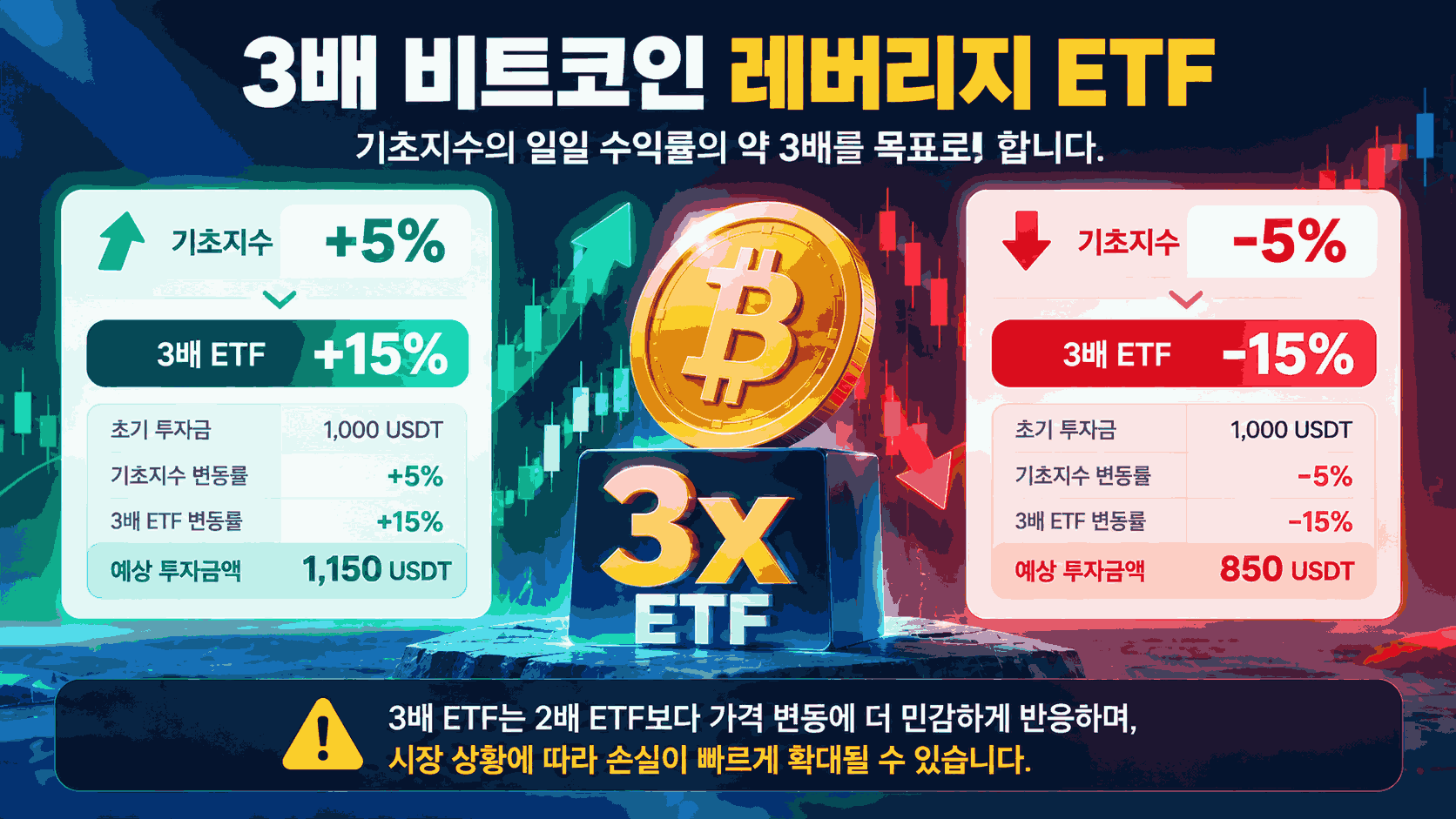
The 3x Bitcoin Leveraged ETF targets 3x daily returns, and both profits and losses can be magnified.
The 3x Bitcoin Leveraged ETF is a product that aims to achieve approximately three times the daily return of the underlying index.
For example, if the index rises 5% for a day, the 3x ETF would target an increase of about 15%. Conversely, if the index falls 5%, the fund value may decrease by about 15%.
Even to the same market fluctuations, a 3x ETF generally reacts more sensitively than a 2x ETF. If Bitcoin continues to decline or shows large fluctuations in multiple directions, cumulative losses can increase quickly.
On October 2, 2026, the U.S. Securities and Exchange Commission (SEC) approved changes to listing and trading regulations for some 3x leveraged products, including Volatility Shares Trust's 3x Bitcoin ETF.
However, approval of changes to listing regulations does not mean the official start of trading for the fund. As of October 8, 2026, this decision alone does not confirm that the 3x Bitcoin ETF is already trading or that its official ticker is active.
Therefore, when looking for a 3x product, you should not rely solely on the name '3x Bitcoin', but check the actual listing status, exchange, and product type.
How to check the types and tickers of Bitcoin leveraged ETFs
A ticker is a transaction code used to identify products in the stock market. Investors can search for ETFs by ticker, but must accurately check the product's investment direction, leverage multiple, and structure.
Bitcoin leveraged ETFs in the US market include the following products:
ticker | Fund name | Daily Target Leverage | characteristic |
BITX | 2x Bitcoin ETFs | +2 times | Use of Bitcoin futures contracts |
BITU | ProShares Ultra Bitcoin ETF | +2 times | Bitcoin-related index tracking |
BTCU | Direxion Daily Bitcoin Bull 2X ETF | +2 times | Utilization of swap based on Bitcoin spot-related products |
SBIT | ProShares UltraShort Bitcoin ETF | -2 times | Tracks changes in the opposite direction to the basic index twice |
BITX and BITU are both upward 2x leverage products, but the underlying index and derivative structure may be different.
BTCU is a product launched on May 27, 2026, and uses a swap structure related to a listed product that provides exposure to Bitcoin spot.
SBIT is an inverse leveraged ETF that aims to profit when the underlying Bitcoin-related index falls. Therefore, SBIT must be distinguished from upward leveraged ETFs.
Here's how to check the Bitcoin ETF ticker:
Search for the product name or ticker on the asset manager’s official website.
Check whether your target rate of return is +2x, +3x, or -2x.
Find out whether the fund is based on Bitcoin spot, Bitcoin futures, or a related index.
Check the investment prospectus for management fees, derivatives, and rebalancing structures.
Check listing status, trading market, and trading conditions in your country of residence.
Some 3x Bitcoin leveraged products in Europe are structured as ETPs or ETNs. It should not be assumed that these products have the same legal characteristics as U.S. ETFs.
Why leveraged ETF returns are not simply ‘leverage multiple × Bitcoin returns’
The cumulative return of a Bitcoin leveraged ETF does not necessarily equal the Bitcoin return over the entire investment period multiplied by the leverage multiple.
The main reasons are daily rebalancing structure, compounding effect, market volatility and operating costs.
Daily rebalancing and compounding effects
Daily Reset is the process by which a fund adjusts its market exposure to maintain its target leverage multiple for the next trading day.
The compound interest effect occurs as daily profits or losses are calculated based on already changed asset values.
Let's assume that the Bitcoin-related index rose 10% on the first day and then fell by about 9.09% on the second day, almost returning to its initial level.
goods | initial value | Day 1 | Day 2 |
basic index | 100 | 110 | about 100 |
2x leveraged ETF | 100 | 120 | About 98.18 |
3x leveraged ETF | 100 | 130 | About 94.55 |
In this example, the underlying index has changed little after two days. But the result is:
The 2x ETF records a loss of approximately 1.82%.
The 3x ETF loses about 5.45%.
This calculation assumes that the ETF accurately achieves its target return each day and incurs no fees or tracking errors.
Conversely, if the index rises for several days in a row, the cumulative return of the ETF may be higher than the value by simply applying the leverage multiple due to the compounding effect.
Therefore, the results of leveraged ETFs are affected not only by the final price but also by the price path throughout the holding period.
Impact of volatility, rollover and costs
The actual rate of return of a Bitcoin leveraged ETF is affected by several factors in addition to the rebalancing structure.
1. Market Volatility
If the price of Bitcoin rises and falls repeatedly by large amounts, it may have a detrimental effect on the cumulative returns of a leveraged ETF. The higher the leverage multiple, the greater this effect generally becomes.
2. Futures contract rollover
Futures-based ETFs may need to liquidate contracts nearing expiration and enter into new contracts.
Differences in futures pricing structures may affect fund performance if the price of the new contract is higher or lower than that of the existing contract. Rollovers do not always incur the same level of cost or loss.
3. Operating fees and financing costs
Leveraged ETFs may incur management fees, derivatives transaction costs, funding costs, and other related costs. The size of the impact varies depending on the product structure.
4. Tracking Error
Tracking error is the difference between an ETF's actual performance and the benchmark return the fund is trying to achieve. These differences may occur in derivatives prices, transaction costs, and portfolio management processes.
5. Exchange rate fluctuations
For Korean investors trading ETFs listed in U.S. dollars, won conversion returns are also affected by the dollar/won exchange rate.
For example, even if the dollar-denominated price of an ETF rises, if the Korean won strengthens significantly against the dollar, the Korean won conversion rate of return may decrease.
Things to keep in mind when investing in Bitcoin leveraged ETF

Bitcoin leveraged ETFs have a high risk of loss, so you should check the daily rate of return, management structure, transaction costs, and holding period.
Bitcoin leveraged ETF is subject to both price fluctuations in the Bitcoin market and risks arising from the leverage structure. Therefore, investors must understand the product structure and the possibility of loss before trading.
The main things to check are:
Daily Target Return: 2x or 3x leverage is generally applied to daily returns and does not guarantee that the long-term cumulative returns will also be the same multiple.
Risk of large losses: If the underlying index moves contrary to expectations, losses may increase depending on the leverage multiple. In extreme situations, you may lose your entire investment.
Product Structure: You should check whether the ETF utilizes Bitcoin spot, futures, swaps, or related assets.
Transaction costs: Management fees, derivatives costs, transaction fees, and differences in bid and ask prices must be checked.
Availability: Even if a ticker appears in a search tool, it does not mean that the product is actually listed or available for trading through all brokerages.
Holding period: The longer you hold your holdings over multiple trading days, the more closely you need to consider the impact of volatility, compounding, and costs.
If you are new to Bitcoin leveraged ETFs, you can calculate returns in hypothetical situations and compare the differences between 1x, 2x, and 3x products over multiple days.
It is also important to note that typical Bitcoin mock trading may not accurately replicate the costs, rebalancing structure, or returns of a specific leveraged ETF.
When understanding Bitcoin leveraged ETFs, not only the leverage multiple is important, but also the difference between daily target returns and cumulative returns. Before choosing a product, you should check the ticker, underlying index, operation method, cost, and risk.
Frequently Asked Questions
1. Does the 2x Bitcoin leveraged ETF always produce double returns?
no. 2x ETFs typically aim to double the daily return of the underlying index. Cumulative returns over multiple days may vary from doubling due to compounding effects, price fluctuations and costs.
2. Where can I find the 3x Bitcoin leveraged ETF?
It can be found on the asset management company's official website, exchange listing information, and investment prospectus. In the United States, the SEC approved changes to the listing rules for the 3X Bitcoin ETF on October 2, 2026. However, this decision alone does not automatically confirm that the fund has already started trading or that an official ticker exists.
3. Are BITX and BITU the same product?
no. Both products aim to track twice the daily rate of change of a Bitcoin-related index, but are operated by different companies and may have different underlying index and derivative structures.
4. Is Bitcoin Leveraged ETF suitable for long-term investment?
The long-term returns of leveraged ETFs cannot be simply predicted based on Bitcoin’s cumulative rise rate alone. Although long-term holding is not always prohibited, investors should understand the impact of volatility, compounding, costs and the fund's investment objectives.
5. What is the difference between Bitcoin leveraged ETF and Bitcoin futures trading?
Bitcoin leveraged ETF is a method of trading ETF shares in the stock market. On the other hand, Bitcoin futures trading involves directly holding futures positions, and margin and liquidation regulations are applied according to the contract.
Although ETFs may utilize futures in their portfolios, this does not mean that investors directly trade futures contracts.
Good article to read together
6 differences between coin spot and futures
Coin futures calculator and leverage profit and loss calculation method
Differences between simulated investment and actual investment
Bitcoin Leveraged ETF is a product that tracks the daily return of Bitcoin-related assets at a certain multiple. 2x and 3x ETFs have different leverage multiples and product structures, and the cumulative returns may differ from simple calculations due to daily rebalancing and compounding effects. Before investing, it is important to check the underlying indices, costs, and risks of major tickers such as BITX, BITU, and BTCU, and understand the impact of leverage by calculating hypothetical returns.
0 Comments
No comments yet. Be the first to share your thoughts.