


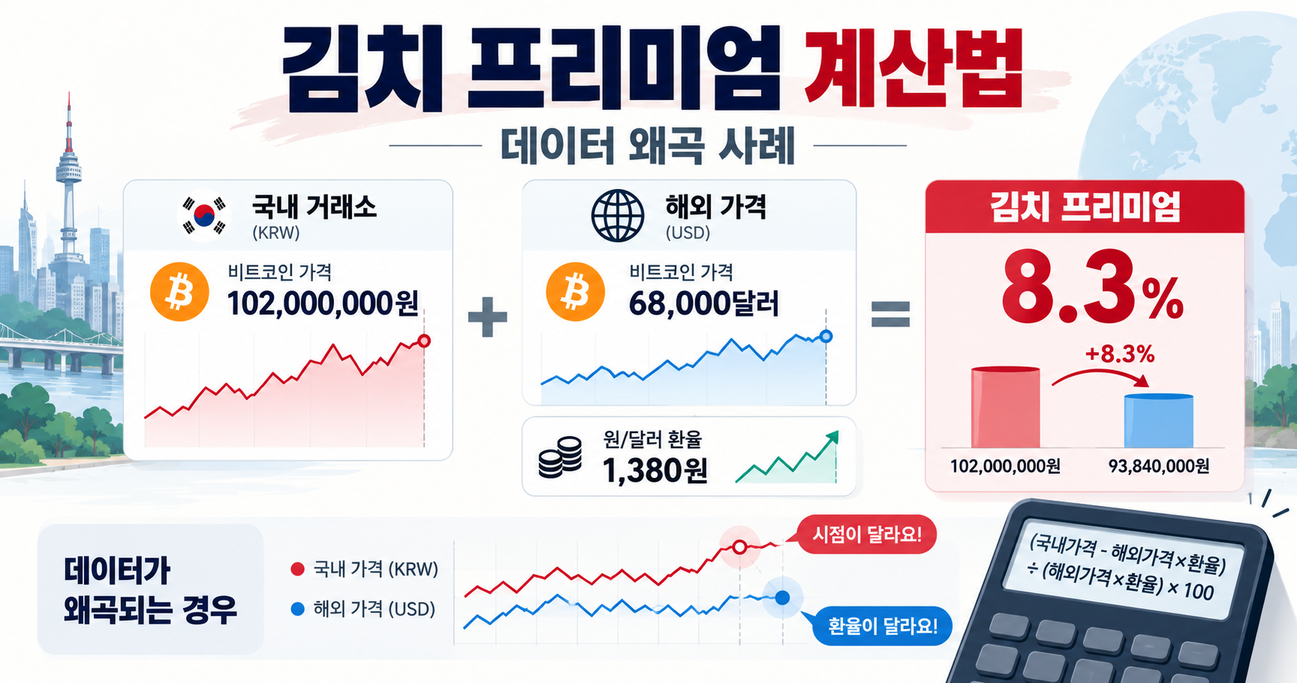
The Kimchi Premium indicator shows the difference in virtual asset prices between domestic won exchanges and overseas exchanges. A phenomenon in which domestic prices are higher when overseas prices are converted to Korean won Kimchi Premium (GIMP)Conversely, if the domestic price is lower, Reverse Premium (Reverse Premium)It is called.
However, the figures shown in this indicator are not returns that can be obtained immediately. To interpret accurately, you must check the comparison target, exchange rate, price point, quote and liquidity, deposit/withdrawal availability, and various costs.
Summary of key points The kimchi premium is a percentage difference between the domestic price and the overseas price converted to Korean won. When calculating, the price of the same asset and the exchange rate at the same time must be applied. The displayed figures may be distorted depending on exchange rate standards, price collection point, liquidity, and deposit/withdrawal restrictions. Since actual costs such as commissions and slippage are not reflected, it should not be assumed to be an investment return or a trading signal. |
What is Kimchi Premium?
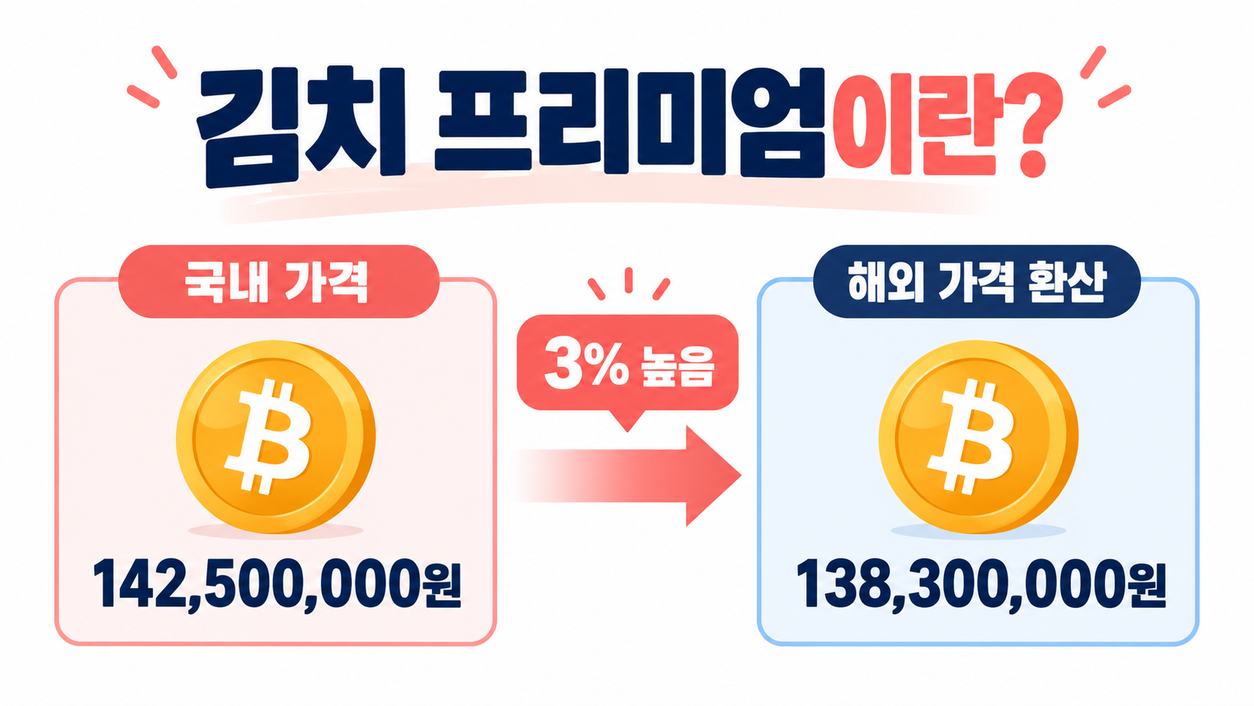
Kimchi Premiumrefers to the degree to which the price of a virtual asset on a Korean exchange is higher than the price of the same asset in an overseas market when converted to the same currency unit. In Korea, it is also called GIMP for short.
For example, if the price of Bitcoin in Korea is 3% higher than the overseas price converted to Korean won, the kimchi premium is 3%.
What is Kimchi Premium?
How to calculate kimchi premium
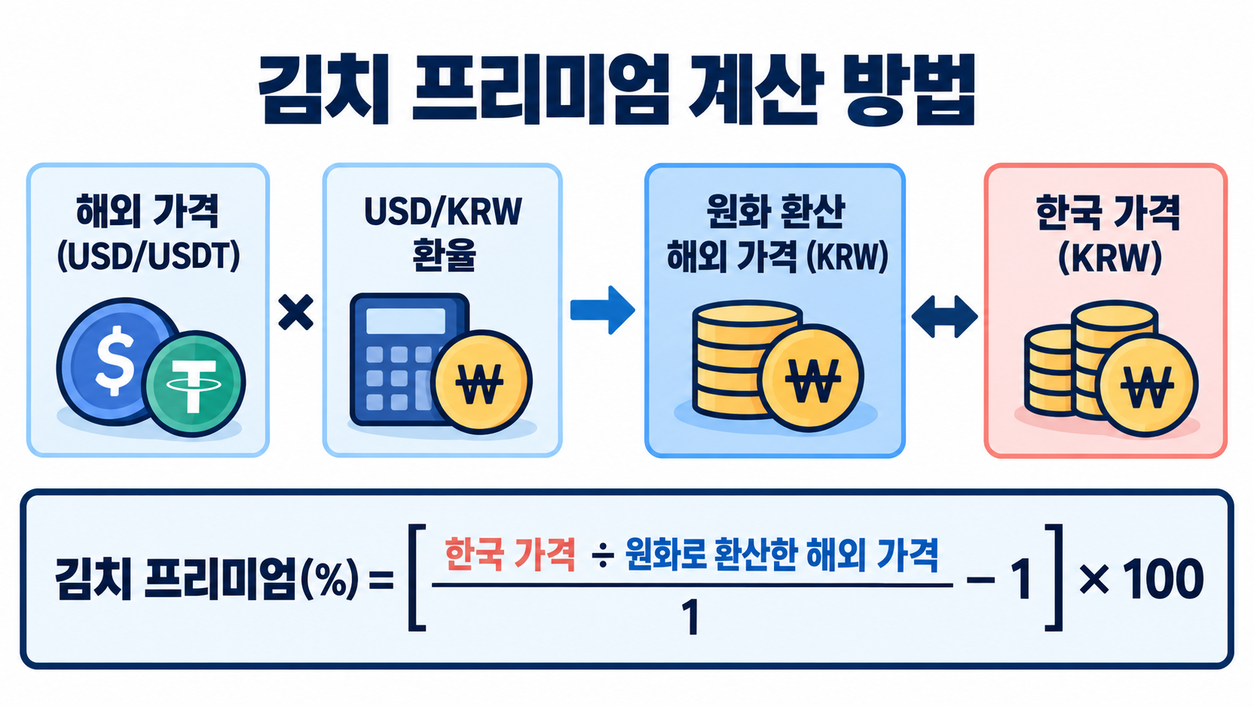
To compare two prices in different currencies Won price by domestic exchangeThe dollar (USD) or tether (USDT) prices on overseas exchanges must be set to the same unit. For this purpose, overseas prices are converted into Korean won using the interbank USD/KRW exchange rate.
Kimchi Premium Calculation Formula
Kimchi premium (%) = [(Korean price ÷ overseas price converted to won) − 1] × 100 |
Positive (> 0%): This means that the price of Bitcoin in Korea is higher than the overseas price, indicating strong domestic purchase demand. In normal market conditions, it usually moves in the range of 0-2%, and if it exceeds 6-8%, the market may face significant volatility.
Negative numbers (< 0%): This means that the price of Bitcoin in Korea is lower than the global market, indicating a discount.
How to calculate kimchi premium
Calculation example
BTC price on Korean exchanges: 145,600,000 KRW
BTC price on foreign exchanges: 100,000 USD
Exchange rate: 1 USD = 1,400 KRW
Overseas BTC price converted to Korean Won: 140,000,000 KRW
Apply the calculation formula: Kimchi Premium = [(145,600,000 ÷ 140,000,000) − 1] × 100 = 4%
As a result of the calculation, the BTC price on the Korean exchange is 4% higher than the standard price. However, this figure does not reflect net profit because it does not reflect commissions, actual execution price, or price changes during the transaction process.
Why does kimchi premium occur?
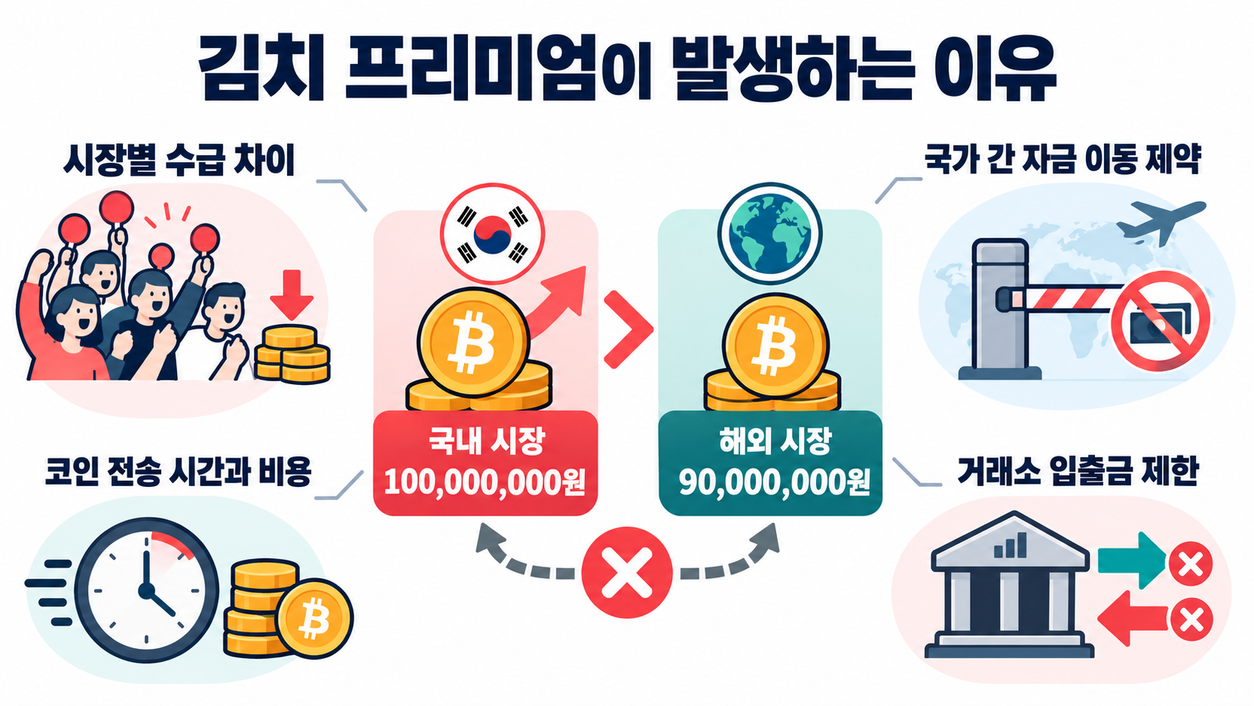
The Kimchi Premium is formed when the demand for coins in Korea is greater than the quantity sold on the market, but there are restrictions on transactions with overseas markets. The main causes are as follows:
Why does kimchi premium occur?
Supply and demand differences by market: The size of buyers and sellers varies from exchange to exchange. If the purchasing power increases significantly in Korea, the coin price may become higher than the overseas price.
Restrictions on cross-border movement of funds: Due to remittance regulations and exchange usage conditions, it is difficult for traders to close the gap by quickly buying coins in a market with low prices and then selling them in markets with high prices.
Time and cost required to transfer coins: The price may change while transferring coins. Not all price differences are suitable for arbitrage, as trading and withdrawal fees also reduce profits.
Exchange deposit and withdrawal restrictions: If coins cannot be transferred to a Korean exchange and sold, further supply is blocked. If buying demand continues to be high, the price gap may remain or even increase.
When Kimchi Premium data is distorted
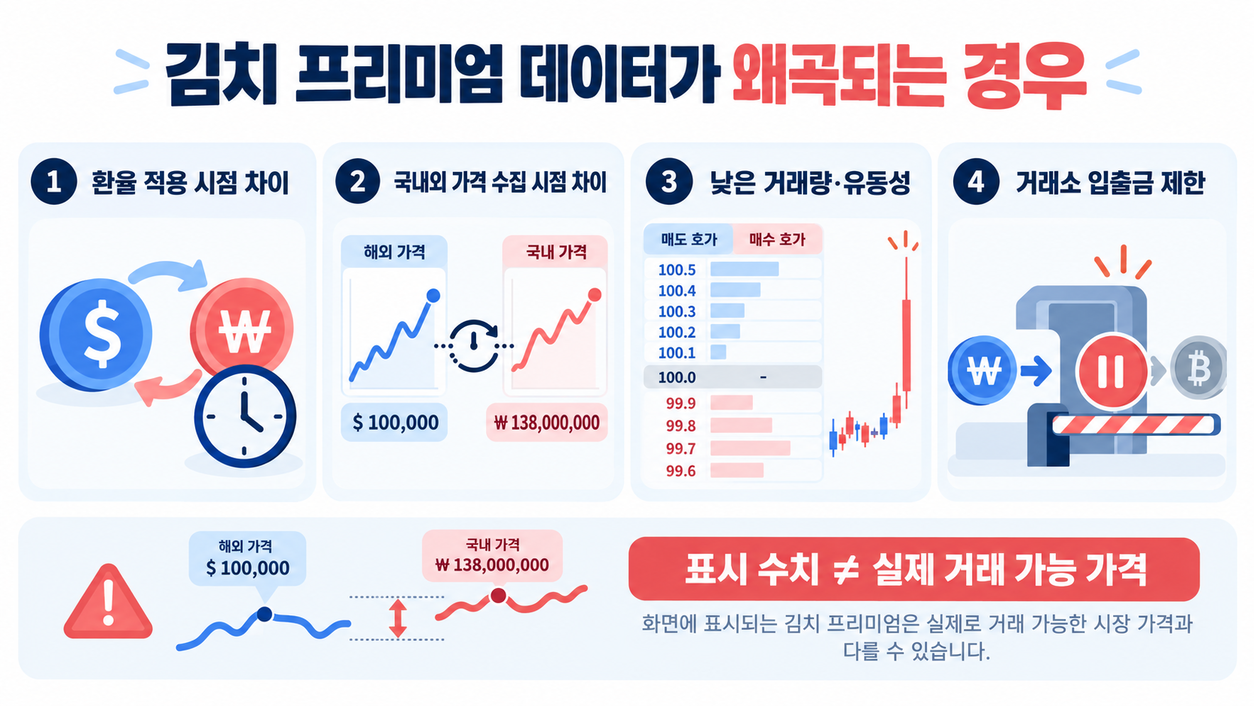
The numbers on the Kimchi Premium tracking screen sometimes do not accurately reflect the actual transaction situation due to technical errors. There are four main reasons why investors fall into so-called ‘virtual price differences’:
When Kimchi Premium data is distorted
When the exchange rate application time is different
Some data sites use the USD/KRW exchange rate based on the bank's previous day's closing price as a fixed value, rather than the real-time market exchange rate. When the value of the Korean Won changes significantly during the day, if you convert the overseas Bitcoin price to the Korean Won using the past exchange rate, a premium that is different from the actual cost can be calculated immediately.
In cases where the overseas price collection point does not match
The API transmission delay between Upbit, a Korean exchange, and Binance, an overseas exchange, can usually vary from a few seconds to about 30 seconds. In areas where market prices move rapidly, comparing prices at different times can create kimchi premium figures that do not actually exist.
When trading volume or liquidity is low
small market capitalization altcoinIn many cases, the bidding window on Korean exchanges is thin and liquidity is lacking. small scale market buy orderThis alone can cause the recent transaction price to soar by 10-20%. In this case, the premium figure may be displayed abnormally high even though it is difficult for investors to sell or purchase the actual volume at the price.
When the exchange restricts coin deposits and withdrawals
If an exchange temporarily suspends deposit/withdrawal wallets due to network maintenance or hard fork, the tokens in question are completely separated from external supply. Since coins from overseas exchanges cannot be deposited into the Korean exchange to balance the price, the price can rise up to 1.5 times due to internal demand alone. In this case, the premium rate appears very high, but arbitrage cannot be executed.
Things to keep in mind when checking kimchi premium
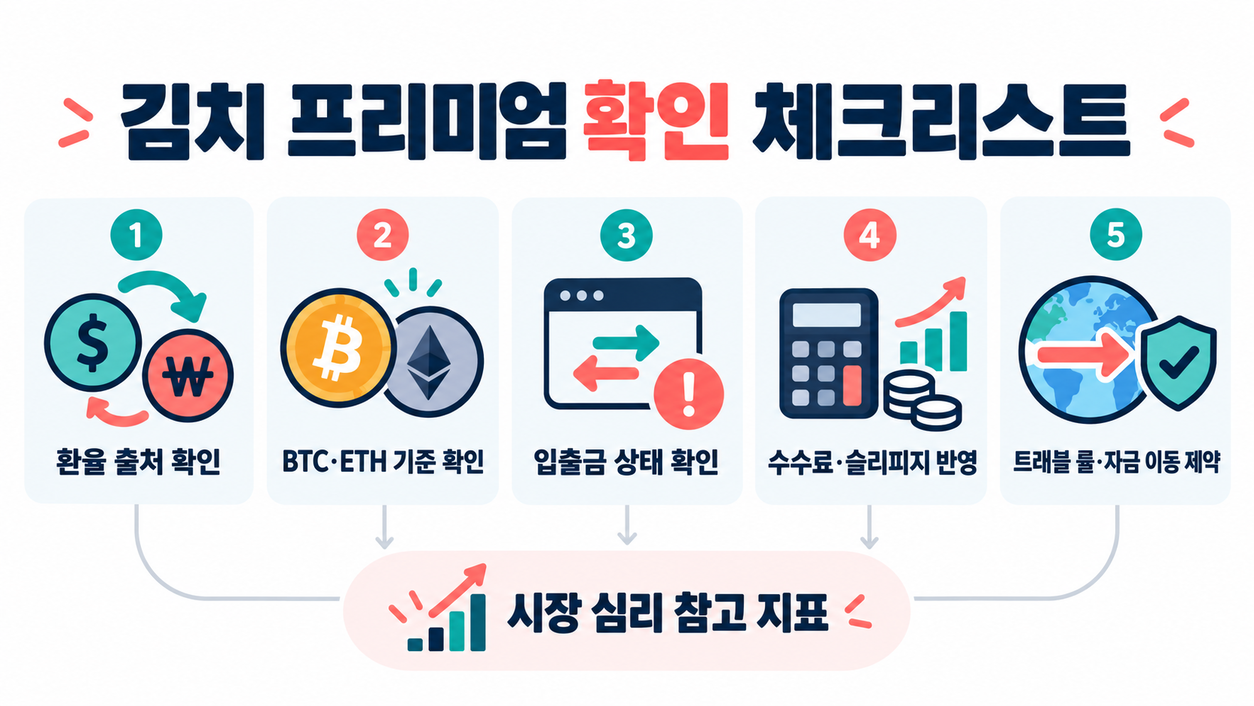
To use the Kimchi Premium as a tool to measure market sentiment without falling into the data trap, you must check the following principles.
Things to keep in mind when checking kimchi premium
Check USD/KRW exchange rate source: Tools include spot FX, bank exchange rates, USDT P2P price You need to check which standard is being used. Lagged exchange rates directly distort premium rates.
Using BTC and ETH as reference indicators: Large data platforms such as CryptoQuant primarily utilize BTC and ETH when measuring macro market sentiment. It is best not to rely on small altcoins whose prices are prone to sudden changes due to low liquidity.
Check deposit/withdrawal wallet status: If the premium of a specific coin rises abnormally The difference between Upbit and Bithumb’s kimchi premium You should check the notices of each exchange. This may be a ‘virtual premium’ caused by the wallet being stopped due to exchange maintenance.
Reflecting the true cost of arbitrage: The price difference displayed on the screen does not include transaction fees, slippage, network gas fees, or delays in transferring coins between exchanges.
Travel rules and foreign exchange transaction law restrictions: Korean exchanges strictly require a verified wallet in the person's name and prohibit illegal remittances. Because of this, moving funds across borders is actually very difficult.
Good article to read together
- Upbit Bithumb Kimchi Premium Difference and Reason for Different Prices
Frequently Asked Questions
1. How should we understand kimchi premium and reverse premium?
The two concepts explain the opposing state of Korean market sentiment compared to global price levels.
Kimchi Premium (positive premium): Appears when the coin price on the Korean exchange is higher than that on the overseas exchange (P_KR > P_Global). This price difference shows the extreme optimism (FOMO) of domestic individual investors, and often overlaps with the period where prices surge during a bull market. When the indicator exceeds 8-10%, the market is often in a short-term overbought state and is at risk of a major correction.
Reverse premium (negative premium/kimchi discount): Appears when the coin price on the Korean exchange is lower than the overseas price (P_KR < P_Global). This state reflects pessimism, selling, or declining interest in domestic private funds, and is often observed during bear markets or when the value of the Korean Won (KRW) suddenly rises significantly. In market cycle analysis, the phenomenon of long-term reverse premiums is often viewed as a signal indicating a mid- to long-term low point in the virtual asset market.
2. Is kimchi premium arbitrage illegal?
It cannot be concluded that it is illegal just because it is a transaction aimed at making a profit from the price difference. Legality depends on the transaction method and relevant country regulations. In Korea, you can be punished if you illegally remit money for kimchi premium transactions or falsely report the purpose of the remittance. Therefore, applicable foreign exchange regulations, anti-money laundering obligations, and reporting obligations must be observed.
3. What is the normal range for kimchi premium?
In sideways or low volatility markets, a price difference of 0% to +2% is generally considered a healthy range. If the figure exceeds 5-7%, speculative sentiment in the Korean market can be considered to have reached a warning level.
Kimchi premium indexcast To interpret it accurately, you must first check the comparative assets, exchange rate, and price calculation time rather than the displayed percentage. The actual tradable price difference may vary if the quote, liquidity, deposit/withdrawal status, and fees are reflected. Therefore, it is necessary to verify whether the value was calculated under the same conditions and then use it as reference material. You should not determine the timing of trading or future profits based on this indicator alone.
0 Comments
No comments yet. Be the first to share your thoughts.